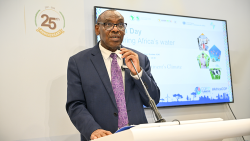
Antalya, Türkiye, 10 November 2026 (ECA) — Too many climate initiatives are celebrated at launch and forgotten at handover. That was the warning issued at a side event convened by the Economic Commission for Africa (ECA) at COP31 in Antalya, where ministers, climate envoys, financiers and former COP champions gathered to answer one question: how do presidential initiatives survive the presidency that created them?
The discussion, held under the theme "From Pledges to Implementation: Delivering on Presidential Initiatives – Lessons for Africa on the Road to COP32", heard that the era of applauding announcements is over. With the world acknowledging that a temporary temperature overshoot is likely within this decade, the test of any initiative is no longer its ambition, it is its delivery.
ECA Executive Secretary Claver Gatete said climate impacts are already costing some African countries an average of 5 per cent of GDP, while high borrowing costs drain resources needed for resilience, energy access and growth. For initiatives to deliver, he set out three tests.
"First, an initiative needs a home beyond the president's authority," Mr. Gatete said. "Political leadership can bring governments, institutions and investors together, but implementation often takes years. Without clear institutional ownership, even promising initiatives can lose momentum when leadership changes."
Second, commitments need financing: announcing an initiative is one thing, securing the resources to implement it is another. Third, results must be visible, through clear targets, realistic timelines and transparent reporting. He cautioned that such arrangements must remain practical, particularly for countries with limited institutional capacity.
"As Ethiopia prepares to host COP32, we must put these lessons to work, strengthening the institutions, financing and partnerships needed to sustain climate initiatives and deliver results for African countries and communities," Mr. Gatete said.
The scale of the delivery gap was laid bare by Hakima El Haite, COP22 High-Level Climate Champion. "We have organized five COPs in Africa with one coming up in Ethiopia, and we are very proud of that. But how many of the initiatives launched by Africans are still alive today? You could probably name only one or two."
The Great Green Wall, she noted, is rarely mentioned at COPs at all. Her prescription: every initiative needs a home embedded in African institutions; Africa needs a dedicated institution to build bankable projects, which her new "Africa Pact" initiative aims to do; and each African COP must build on the one before it.
El Haite also confronted the cost-of-capital barrier head-on. African projects fail, she argued, not because of actual risk but because of the perception of risk. "We are paying more for loans than anyone, anywhere. It is time for us to have access to the money."
She called on the Green Climate Fund to simplify access for African countries, noting that very few African entities are accredited, and urged negotiations on a debt pause to free fiscal space for climate investment.
Nigel Topping, UK COP26 High-Level Climate Champion, identified a structural flaw in the process itself: each presidency reshuffles the global economy into a new set of thematic tracks, forcing everyone to spend 11 months a year figuring out what the president is focusing on. He urged the incoming Ethiopian presidency to keep the axes defined by Brazil's COP30 as the source of continuity.
An institutional home is needed, he said, but one that works with businesses, cities and investors rather than a purely governmental one. And private finance must be invited in as problem-solving partners: "The checkbook comes after the play, not before it."
Alice Amorim, Director of Programmes at COP30's Brazilian presidency, added that the answers rarely sit with ministries of foreign affairs or environment alone — finance, energy and other line ministries must own the work for it to go beyond hosting events.
Benoît Faraco, France's Special Envoy for Climate and Energy, was blunt about why pledges under-deliver in Africa. "If we put more money in the same basket, it will not deliver more implementation in Africa. Only 20 per cent of investments are going to renewable energy, despite the immense potential in Africa."
He called for greater accountability in the Action Agenda, tracking the last mile of where pledged money actually goes and proposed a Europe-Africa partnership to build collective value chains for electrification goods, from batteries to solar equipment. "We don't want to replace our dependency on fossil fuel with a dependency on one superpower that produces every solar panel and battery. We can produce those batteries in Europe and in Africa."
The Green Climate Fund's Chief Investment Officer, Amer Baig, pointed to signs of progress: the Fund now processes transactions in nine months or less, directs over 62 per cent of its adaptation finance to Africa and least developed countries, and counts over a third of its direct-access entities in Africa. "More capital is needed, but the question is how it is deployed, and this is where the partnership model becomes critical."
The road to Addis Ababa
Samuel Addis Alemayehu, Delivery Lead for COP32, assured the session that Ethiopia's presidency is built for continuity. Initiatives under preparation follow three principles: they should be multisectoral, an afforestation initiative, for example, should also create jobs and support food security; they should outlive the presidency; and they should generate measurable impact for the continent.
"Whatever we work on should be sustainable and should strengthen public services," he said, stressing the critical role of ministers of finance. "This is the time for all of us to uphold the Paris Agreement and accelerate implementation. Our presidency is ready to engage with all partners and work on some of the ideas raised here."
The ECA session is part of the Commission's work to help establish a governance ecosystem for climate implementation, drawing on lessons from successive COPs as Africa prepares to host COP32 in Addis Ababa in 2027.
Issued by:
Communications Section
Economic Commission for Africa
PO Box 3001
Addis Ababa
Ethiopia
Tel: +251 11 551 5826
E-mail: eca-info@un.org
Communications Section
Economic Commission for Africa
PO Box 3001
Addis Ababa
Ethiopia
Tel: +251 11 551 5826
E-mail: eca-info@un.org