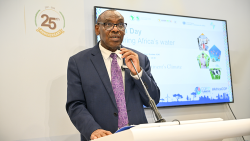
Windhoek, Namibia, 11 November 2026 (ECA) – Senior government officials, ministers, regional institutions, development partners, private sector representatives and experts from across Eastern and Southern Africa have gathered in Windhoek, Namibia, for the Joint Session of the Intergovernmental Committee of Senior Officials and Experts (ICSOE), to discuss practical solutions for strengthening regional integration through connectivity, trade and investment.
The four-day meeting, jointly organized by the Government of Namibia and the United Nations Economic Commission for Africa (ECA) through its Offices for Eastern and Southern Africa, under the theme"Bridging Eastern and Southern Africa: Connectivity, Trade and Investment for a More Integrated Continent."
Opening the meeting, which brought together representatives from 25 countries, including nearly eight ministers, Ericah B. Shafudah, Namibia's Minister of Finance, called on African countries to move beyond the promise of regional integration and focus on concrete actions that can accelerate implementation and deliver tangible development results.
"We must move beyond discussing the potential of regional integration and concentrate on the practical measures required to make it work. This includes improving transport infrastructure, harmonising customs procedures, removing unnecessary trade barriers, strengthening energy and digital connectivity, and creating a more conducive environment for cross-border investment," she said.
The Minister noted that despite progress under regional economic communities and the African Continental Free Trade Area (AfCFTA), trade between African countries remains below its potential. She emphasized Namibia's strategic role in regional trade through the Port of Walvis Bay and the Walvis Bay Corridor Network, which connect several countries in Southern and Central Africa to international markets.
"Namibia remains open for trade and investment. We see regional integration not as competition between our economies, but as an opportunity to complement one another, expand markets and build stronger African industries," Minister Shafudah added.
Speaking on behalf of ECA, Eunice Kamwendo, Director of the ECA Subregional Office for Southern Africa , challenged participants to focus on concrete outcomes and partnerships capable of addressing long-standing barriers to regional trade and investment.
"Our theme asks a very practical question: what can our two subregions achieve together that each would struggle to deliver on its own?" she said. "The challenge before us is how to transform opportunities into bankable projects, mobilize capital where it exists and implement solutions that improve connectivity, trade and investment across our regions."
Kamwendo highlighted the need for stronger energy connectivity, digital integration and innovative financing mechanisms to support regional development. She noted that while Eastern and Southern Africa collectively possess significant energy generation capacity, transmission bottlenecks continue to limit the exchange of electricity and constrain industrial development.
Addressing participants earlier in the opening session, Hopolang Phororo, United Nations Resident Coordinator in Namibia, emphasized that regional integration must be driven by practical economic outcomes. [
"The AfCFTA gives us the space to make a different choice. But an agreement does not create a market by itself. That depends on what we produce, whether goods can move efficiently, whether businesses can operate across borders, and whether our countries are prepared to make their systems work together," she said.
She further noted that the continent must decide whether it will continue exporting raw materials for processing elsewhere or build competitive regional value chains capable of creating jobs, investment opportunities and industrial growth within Africa.
Discussions throughout the four-day session are focusing on energy connectivity, regional trade facilitation, productive finance, digital integration, cross-border investment and tourism. Participants have also reviewed macroeconomic developments in Eastern and Southern Africa and identify policy recommendations to support implementation of regional and continental priorities.
The Joint ICSOE meeting runs from 10 to 13 November 2026 and is expected to produce recommendations that will inform national, regional and continental efforts to accelerate economic integration, industrialization and sustainable development across Eastern and Southern Africa.
For media inquiries
Mr. Didier Habimana
Communication Officer
United Nations Economic Commission for Africa
Subregional Office for Eastern Africa
habimanad@un.org
Ms. Lavender C. Degre
Communication Officer
United Nations Economic Commission for Africa
Subregional Office for Southern Africa
lavender.degre@un.org
Issued by:
Offices for Eastern and Southern Africa
United Nations Economic Commission for Africa