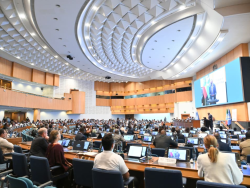
Yaoundé, 23 October 2026 — Cameroon is taking the next step in developing its first energy accounts, a statistical framework designed to guide investment and energy policy. From 26 to 30 October 2026, the National Institute of Statistics (NIS) will convene a national workshop on methodology and preliminary compilation in Soa, near Yaoundé. The workshop will receive technical support from the United Nations Economic Commission for Africa (ECA), through its Subregional Office for Central Africa and African Centre for Statistics (ACS). Its aim is to establish common compilation methods and begin applying them to the available data.
The meeting builds on the first workshop to identify data and user needs, held in Douala from 22 to 26 June 2026. That workshop mapped information sources, clarified users’ requirements and identified data gaps, particularly for biomass and self-generated electricity. In Soa, experts will translate these findings into calculation methods and consistent tables that the institutions involved can use.
The workshop will focus on the physical supply and use table for energy (PSUT). This table shows where energy comes from and how it is used by industries and households. It tracks production, imports, transformation and consumption, as well as energy losses.
To compile the table, experts will review existing data and map them to the relevant accounting categories. They will harmonize energy product classifications and the conversion factors needed to compare quantities measured in different units. They will also document methods for estimating missing data. These common rules should make it possible to reconcile information from different sources and verify the resulting calculations.
The team will also define the monetary tables to be used and ensure that the energy accounts are consistent with national accounts. This will allow physical quantities to be analyzed alongside monetary values. Participants will agree on rules for classifying and allocating flows, including the residence principle, under which transactions are attributed to resident economic units, such as businesses and households.
Over time, linking these accounts should help assess the energy needs of different industries and measure energy use per unit of value added, an indicator of energy intensity. This will help inform decisions on expanding supply and managing demand. The work will follow the recommendations of the System of Environmental-Economic Accounting for Energy (SEEA-Energy).
The workshop will bring together 27 participants from government bodies, energy sector organizations and institutions that use the data, including two ECA experts. It will cover petroleum products, electricity, natural gas, biomass and traditional fuels, as well as renewable energy. A cross-cutting group will address consistency with national accounts and methods common to the different energy subsectors.
Expected outputs include a national methodological reference document, an initial energy PSUT populated with available data, and functional specifications for the tools to be used in compilation. These specifications will set out what the tools must do to apply the agreed methods and support regular updates. Experts will also identify the remaining steps needed to prepare the pilot phase.
Funded through the HISWACA project, the workshop will lay the groundwork for developing, configuring and testing compilation tools. It will also contribute to the implementation of Cameroon’s National Plan for the Development of Environmental-Economic Accounting.
The broader objective is to provide Cameroon with regularly updated information on the links between energy, the economy and the environment. Through its continued support to NIS and the relevant public institutions, ECA is helping build the evidence base to better target investment, monitor energy losses and evaluate energy policy. The accounts should inform decisions to improve the reliability of energy supplies for households and businesses, strengthen industrial competitiveness and support an energy transition aligned with Cameroon’s National Development Strategy 2020–2030 (NDS30) and Vision 2035.
Queries
Zacharie Roger MBARGA - Communications Officer
United Nations Economic Commission for Africa
637, rue 3.069, Quartier du Lac, Yaoundé, Cameroon
Tel: (+237) 222504348
E-mail: zacharie.mbargayene@un.org
Issued by:
Communications Section
Economic Commission for Africa
PO Box 3001
Addis Ababa
Ethiopia
Tel: +251 11 551 5826
E-mail: eca-info@un.org