

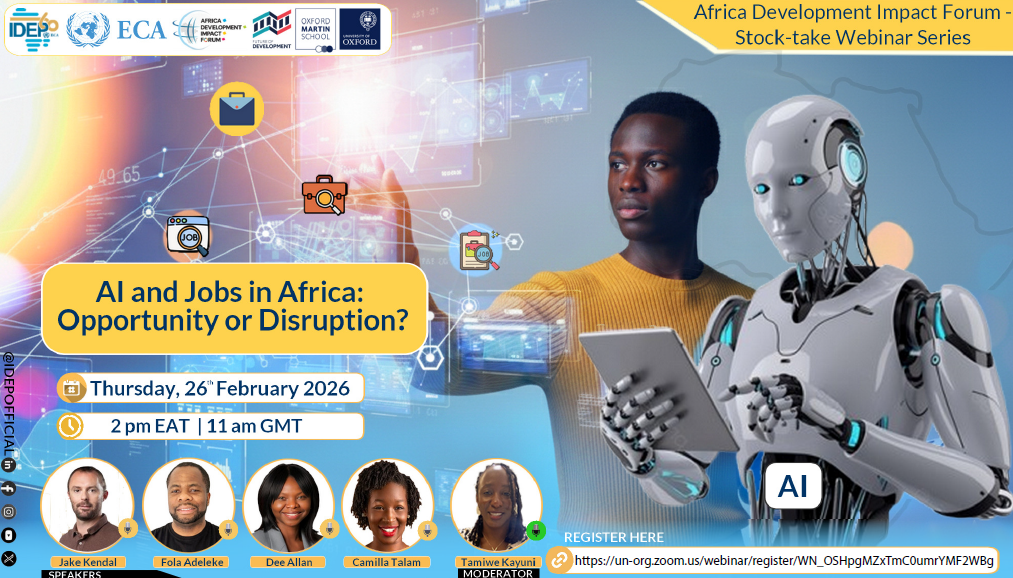
Register here
Artificial intelligence (AI) is already reshaping how work is organised, how firms grow, and how economies compete. For Africa, a continent with the youngest population in the world and a labour force expected to grow by over 450 million people by 2035 (The Africa Competitiveness Report, 2017), the stakes could not be higher.
Will AI become a catalyst for job creation, productivity, and inclusive growth? Or will it deepen inequalities, disrupt fragile labour markets, and widen the gap between skills and opportunity?
These are the questions at the heart of an upcoming webinar on Thursday, 26 February 2026 hosted by the Oxford Martin School’s Future of Development Programme, in collaboration with the United Nations Economic Commission for Africa (UNECA) and its new flagship initiative, the Africa Development Impact Forum (ADIF).
The webinar will bring together voices from research, policy, investment, and practice to focus on one core challenge: what does meaningful job creation look like in the age of AI and what must Africa do now to shape that future?
Why This Matters Now
Africa is entering a critical demographic and economic transition:
- The continent’s labour force is expanding faster than anywhere else in the world; surpassing India’s in 2023 and projected to hit over one billion workers by 2043 (Africa Futures, AUDA-NEPAD, 2025).
- Yet, about 85% of employment in Africa remains informal, meaning many workers lack stable contracts, benefits, and pathways to upskilling (Africa Futures, AUDA-NEPAD, 2025)
- Every year, 10-12 million young Africans enter the workforce, but only around 3 million formal jobs are created, leaving millions without decent employment (ADB Jobs For Youth Strategy, 2016-2025)
Across the globe, AI is already transforming labour markets:
- Automation and AI tools are reshaping tasks in manufacturing, agriculture, services, and the public sector.
- Generative AI is changing how work is done in areas such as coding, design, research, and customer services.
- Demand is growing for new skills, while many traditional roles are being redefined or eliminated.
The AI Frontier: Promise and Peril
New technologies are creating exciting new ways for people to work; with digital services to tools that make tasks faster and more efficient. Studies suggest that by 2030, up to 40% of tasks in Africa’s tech outsourcing sector could change because of these technologies. This shift could create opportunities for higher-value, better-paid work, but only if the right skills are taught and the right policies are in place.
At the same time, this transformation raises real concerns:
- Automation could affect many lower-skilled jobs, which make up a large part of the workforce, especially in the informal sector.
- Gaps in skills and access to technology may mean that not everyone can take advantage of new opportunities.
- Without clear policies and investments, there is a risk that inequality could increase instead of decrease.
AI therefore presents a paradox: it could leapfrog constraints and create new forms of work, or it could lock countries into low-value roles if policy, investment, and governance do not keep pace. AI’s role in shaping that future cannot be ignored.
A Continental Conversation Linked to Action
This webinar, “AI and Jobs in Africa: Opportunity or Disruption?” is part of the pre-forum stock-take series for the Africa Development Impact Forum (ADIF), which will convene in June 2026 under the theme: Best Practices and Innovative Solutions for Job Creation in Africa. ADIF is designed as an action-oriented platform, explicitly focused on bridging the gap between applied research and policy implementation. Its three-stage model combines:
- Evidence-based dialogue and challenge-setting,
- Co-design and policy commitments at the annual forum, and
- A 12-month “Implementation Clock” to support learning, monitoring, and scaling what works.
What the Webinar Will Explore
The session will bring together voices from research, policy, investment, and practice to examine:
- Africa’s readiness for AI: infrastructure, skills, data, and institutions
- How AI may reshape employment structures, task composition, and productivity
- Where AI could enable new sectors, firms, and forms of work
- The risks of exclusion and how policy and governance can mitigate them
- What governments, innovators, investors, and development partners are already doing to turn AI into a job-creating force
Rather than framing AI as either a threat or a silver bullet, the discussion will focus on choices, trade-offs, and pathways.
Join us:
Webinar: AI and Jobs in Africa: Opportunity or Disruption?
Date: Thursday, 26 February 2026, 11am-12:30pm (GMT)
Link: https://un-org.zoom.us/webinar/register/WN_OSHpgMZxTmC0umrYMF2WBg#/registration
Hosted by: UNECA and the Africa Development Impact Forum (ADIF)
In collaboration with: Oxford Martin School’s Future of Development Programme