
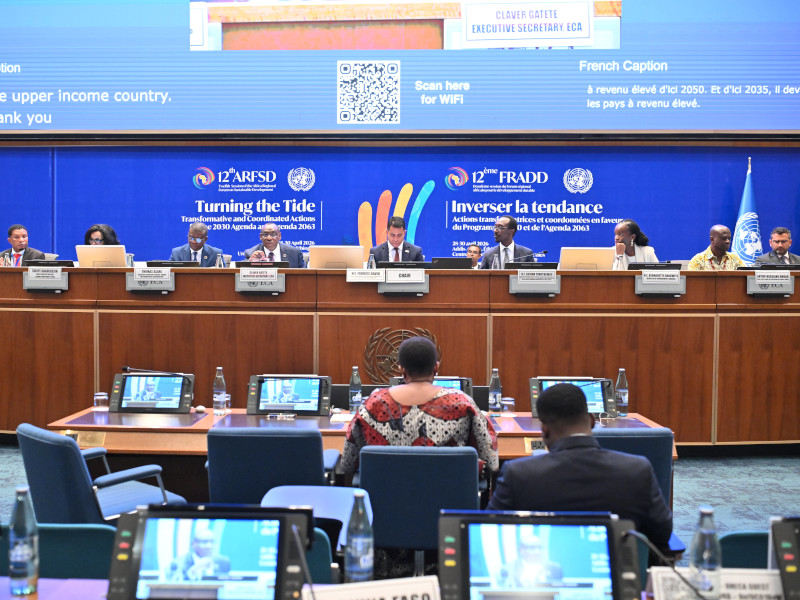
Addis Ababa, 28 April 2026 - Africa’s development ambitions are not being held back by lack of vision, but by the scale, cost and structure of financing available to deliver them, speakers said during two high-level panels at the twelfth Africa Regional Forum on Sustainable Development.
The discussions, held under the themes of scaling up transformative and coordinated action for the 2030 Agenda and Agenda 2063, and unlocking finance for climate resilience and sustainable development in Africa, brought together ministers, continental institutions, development finance leaders, climate negotiators, civil society and international organizations.
A central message echoed among the panelists: Africa’s challenge is not ambition, but delivery. Delivery, speakers stressed, requires affordable finance, stronger domestic systems, bankable project pipelines, credible data and a reformed global financial architecture that responds to Africa’s realities.
ECA Executive Secretary Claver Gatete, who moderated the two sessions, said Africa must protect climate and development investments even under severe fiscal pressure. He emphasized that reducing risk, whether currency risk, climate risk or policy risk, is central to mobilizing both domestic and private capital.
Speakers noted that Africa continues to face a disproportionately high cost of capital, driven in part by weaknesses in the international financial architecture. Credit rating methodologies, risk-weighting practices and capital adequacy frameworks were cited as factors that constrain investment in climate resilience, infrastructure and sustainable development.
Timothewos, Ethiopia’s Minister of Foreign Affairs and President-Designate for the thirty-second Conference of the Parties to the United Nations Framework Convention on Climate Change, set the strategic context by grounding the discussion in both African responsibility and global leadership.
“Africa’s experience with sustainable development continues to highlight a central challenge – persistent structural barriers, large financing gaps, rising debt burdens declining investment and high cost of capital are eroding hard-won development gains.”
“The COP32 Presidency of Ethiopia will consistently frame comate action as an integral part of sustainable development and poverty eradication. Implementation will be at the core of our presidency, strengthening institutions and accelerating support for delivery of national adaptation plans and log-term strategies,” he added.
Panelists said climate finance flows remain imbalanced, unpredictable and heavily tilted toward mitigation, while grant-based resources for adaptation, loss and damage, and disaster risk reduction remain insufficient. This mismatch, they said, fails to reflect Africa’s vulnerability and development needs.
Aakif Merchant, Director and Head of Africa at Convergence Blended Finance, presented strategic perspectives on the Sevilla Platform of Action on unlocking finance for climate resilience and sustainable development, highlighting the role of blended finance in moving promising instruments from pilot stage to scale.
Rwanda’s experience was also cited as an example of how climate resilience can be integrated into national development planning. Bernadette Arakwiye, Rwanda’s Minister of Environment, shared lessons from the country’s shift from implementing fragmented projects to country-led investment platforms that aligned along clear national priorities, such as green budgeting, environmental funds and strong institutional coordination to align domestic and international climate finance with development priorities.
Antwi-Boasiako Amoah, Chair of the Africa Group of Negotiators on Climate Change, stressed the need for fair, predictable and accessible finance aligned with Africa’s development realities and less pledges, stressing predictable, accessible grant-based and concessional financing to support adaptation and resilience, just transition loss and damage and green industrialisation.
Tariye Gbadegesin, Chief Executive Officer of the Climate Investment Funds, underlined the importance of large-scale climate finance platforms in accelerating the transition from isolated pilot projects to scalable solutions that can support green industrialization and resilience across the continent. She noted growing evidence that investing in resilience, safeguarding food systems water systems power supplies businesses and jobs offers economic return.
Thomas Asare, Assistant Secretary-General from the World Meteorological Organization, emphasized the role of climate risk data and early warning systems in financial innovation. He said such data can be integrated into instruments including resilience bonds and debt-for-climate swaps to attract private investment at scale.
Civil society also called for stronger climate finance justice. Mithika Mwenda of the Pan-African Climate Justice Alliance said Africa must ensure the transparent, equitable and accountable use of both domestic and international resources, while underscoring the need for grants in a context of dwindling financing.” We must reclaim the Common, but Differentiated Responsibilities and Respective Caabilities of Countries under the Paris Agreement. Those who contributed most to the crisis and have the greatest capacity must do the most.
In the second panel, Mthuli Ncube, Minister of Finance of Zimbabwe, stressed the importance of strengthening domestic resource mobilization while protecting long-term climate and development investments. He noted that this must be done in a context of constrained fiscal space, rising debt service pressures and the need for risk mitigation and financial innovation.
Jean-Bertrand Azapmo, Principal Adviser to the Commissioner of the African Union Commission’s Department of Economic Development, Trade, Tourism, Industry and Minerals, called for a coherent continental framework linking climate finance with green industrialization and regional value chains under the African Continental Free Trade Area.
Coulibaly Abdoulaye of the African Development Bank highlighted the connection between global reform and domestic capital formation. He said systemic reforms to the global financial architecture and sovereign credit systems are needed to reduce Africa’s cost of capital and enable stronger domestic capital markets.
N’Sonde Regis, Executive Director at the International Monetary Fund, said further analysis and support are needed to help African countries unlock more climate and development finance without worsening debt vulnerabilities.
Olapeju Ibekwe of Sterling One Foundation emphasized the contribution of philanthropic and non-state actors in strengthening accountability, mobilizing partnerships and ensuring that finance translates into concrete development outcomes.
Across both panels, speakers warned that fragmented, project-based delivery of climate and development finance limits scale, coherence and impact. They called instead for integrated and programmatic approaches aligned with national plans, the Sustainable Development Goals and Agenda 2063.
The discussions also pointed to weak domestic resource mobilization and public financial management systems as major constraints. Low tax effort, inefficiencies and limited capacity to ring-fence resources were identified as barriers to financing climate-resilient infrastructure and services.
Panelists further noted that many African countries lack sufficient pipelines of investment-ready and bankable climate projects. Limited technical capacity for project preparation, risk structuring and public-private partnerships, they said, continues to impede the mobilization of finance at scale.
The underuse of regional and continental financing mechanisms was also highlighted. Speakers called for stronger African development finance institutions and greater use of innovative instruments such as green bonds, sustainability-linked bonds, debt-for-climate swaps and Africa-tailored carbon market mechanisms.
The Forum underscored that data, transparency and accountability are not optional. They are foundational to investor confidence, public trust, effective delivery and climate justice.
Participants called for stronger continental coordination, particularly through the African Union. The AfCFTA was highlighted as a key platform for linking climate finance with green industrialization, regional value chains and structural transformation.
The panels agreed that ECA member States should strengthen domestic resource mobilization and public financial management systems, build integrated and investment-ready pipelines of climate and sustainable development projects, and establish transparent national systems for tracking climate and development finance.
ECA was called upon to strengthen regional monitoring, policy coherence and follow-up on financing commitments, including by supporting member States to translate the outcomes of the Fourth International Conference on Financing for Development and the Conferences of the Parties into coherent national financing strategies, implementation plans and measurable results.
Regional and continental institutions were urged to strengthen financing mechanisms capable of crowding in public and private capital at scale, while building coherence between climate finance and integrated delivery across energy, water, transport, industry, cities, health and resilience.
International financial institutions and development partners were called upon to support reforms to the international financial architecture and provide scaled-up, predictable and concessional climate finance, particularly for adaptation, loss and damage, and disaster risk reduction.
The two panels converged on Africa’s readiness to lead through reform, innovation and accountability and the need for leadership that is matched by a global financial system that delivers. In addition, partners that align with African priorities, and financing that reaches the scale required for climate resilience and sustainable development.
Issued by:
Communications Section
Economic Commission for Africa
PO Box 3001
Addis Ababa
Ethiopia
Tel: +251 11 551 5826
E-mail: eca-info@un.org