
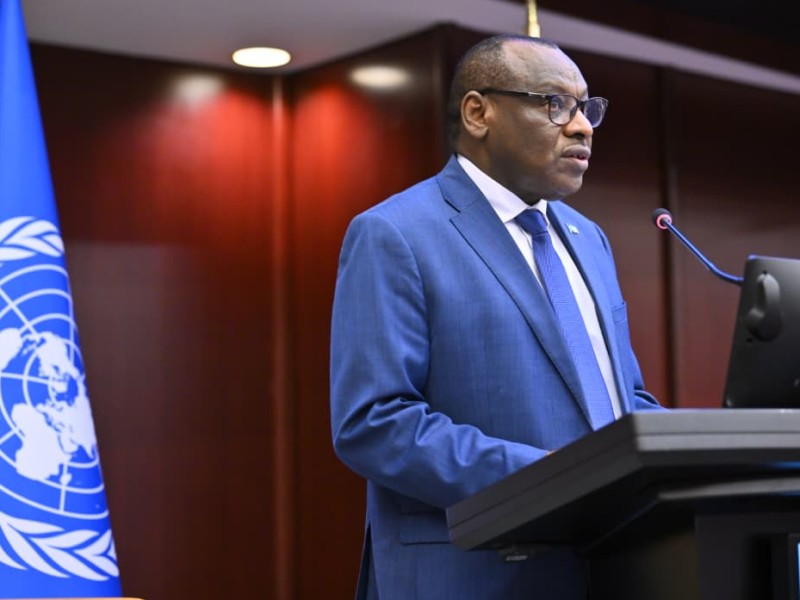
EIGHTH AFRICAN SCIENCE, TECHNOLOGY AND INNOVATION FORUM
Theme:
Achieving progress towards the 2030 Agenda and Agenda 2063 through transformative and coordinated actions in science, technology and digital innovation
Statement
By
Mr. Claver Gatete
United Nations Under-Secretary-General and
Executive Secretary of ECA
Addis Ababa, Ethiopia
26 April 2026
H.E. Dr. Belete Molla, Minister of Innovation and Technology, Ethiopia,
H.E. Dr. Monica Musenero Masanza, Outgoing Chairperson, Minister of Science, Technology and Innovation, Uganda,
Dr Rita Bissoonauth, Director of the UNESCO Addis Ababa Liaison Office to AU, UNECA and UNESCO Representative to Ethiopia
Prof. Saidou Madougou, Director of Department of Education, Science, Technology & Innovation, AUC,
Honourable Ministers,
Distinguished Heads of Delegation,
Esteemed Representatives of the African Union and the United Nations System,
Leaders from the Private Sector, Academia and Civil Society,
Ladies and Gentlemen:
It is my pleasure to welcome you all to the Economic Commission for Africa in Addis Ababa for the Eighth African Science, Technology and Innovation Forum, convened under the theme: “Achieving progress towards the 2030 Agenda and Agenda 2063 through transformative and coordinated actions in science, technology and digital innovation.”
Your presence here – from across Africa and beyond, both in person and online – signals a shared conviction: that Africa’s future will be shaped not only by what we extract, but by what we invent; not only by what we consume, but by what we create.
Permit me to begin by thanking the Government and people of Ethiopia for their leadership and hospitality, and in particular to H.E. Dr. Belete Molla, for his presence and reliable support.
I also extend sincere thanks to our partners – the African Union Commission, the United Nations system, our development partners, the private sector, academia and civil society for your collaboration in advancing Africa’s science, technology and innovation agenda.
Excellencies,
Distinguished Delegates,
We meet at a defining moment – just days before the opening of the 12th Session of the Africa Regional Forum on Sustainable Development – and at a time when the global development terrain is undergoing profound transformation.
Across the world, we are witnessing slower economic growth, tightening financial conditions, rising debt vulnerabilities, intensifying climate shocks and increasing geopolitical fragmentation reshaping trade and investment patterns.
Alongside these developments, a rapid technological revolution – driven by data, artificial intelligence, biotechnology, blockchain and the Internet of Things – is redefining competitiveness, productivity and even the nature of governance itself.
But what does this mean for Africa?
It means that the margin for delay has disappeared.
It means that the cost of inaction is rising.
And it means that the choices we make today will determine whether we catch the next wave of global transformation – or miss it entirely.
And yet, even as opportunities expand, the reality on our continent remains deeply uneven.
According to ITU, internet usage in Africa stood at just 36% in 2025, with glaring divides between urban and rural areas, and between men and women.
The continent’s contribution to global innovation is also limited, accounting for only 0.6% of global patent applications, despite representing nearly one-fifth of the world’s population.
These are signals of untapped potential but also of urgent gaps we must close.
The question is will Africa simply adapt to technologies shaped elsewhere, or will it play a decisive role in shaping how these technologies are designed, governed and deployed?
And in doing so, will innovation reinforce existing inequalities, or can it become the great equalizer –expanding opportunity, inclusion and shared prosperity across our continent?
These questions, Excellencies, are immediate, practical and consequential.
Because science, technology and innovation, far from being optional accelerators of development, are the foundation upon which progress towards the 2030 Agenda and AU Agenda 2063 will either be built or stalled.
We don’t need to look far to see what works.
For example, in Kenya, climate-smart agricultural technologies are increasing crop yields by up to 20% while reducing input costs.
In Rwanda, drone-based medical delivery systems have reduced wastage by 67% and cut stockout times by 60% transforming health supply chains.
This is what aligned innovation looks like – it delivers not just efficiency, but lives saved, improved incomes and stronger systems.
If we are to turn things around, then we must be deliberate – in how we invest, in how we build capabilities and in how we coordinate across our African economies.
Allow me, therefore, to propose five strategic priorities to guide our deliberations.
First, Africa must align science, technology and innovation with its economic transformation agenda, otherwise we risk innovation without impact.
From Morocco’s industrial value chains in automative and renewable energy to South Africa’s use of advanced manufacturing and digital tools, we know that innovation can and must translate into production, value addition and job creation.
Second, Africa must accelerate investment in digital public infrastructure.
Without robust digital systems – digital identity, interoperable payments and trusted data platforms – innovation cannot scale.
From Egypt’s precision agriculture improving water efficiency, to Ghana’s mobile health platforms expanding access to care, and Botswana’s digital public services enhancing delivery and trust, we see how digital systems are already transforming lives.
Third, we must build future-ready skills at scale.
A continent with the world’s youngest population cannot afford a mismatch between education systems and the demands of the digital economy.
For instance, across West Africa, digital skills initiatives and innovation hubs across cities like Lagos and Accra are expanding opportunity.
And yet, gaps in digital skills are a binding constraint across many countries.
We must therefore invest in science, engineering, AI and emerging fields, while ensuring that women and youth are fully included in this transformation.
Fourth, we must deepen regional and continental coordination.
Innovation cannot scale in fragmented markets, but it accelerates in integrated ones.
Through the African Continental Free Trade Area, Africa has a unique platform to expand digital solutions, harmonize regulations and develop regional value chains.
Whether in pharmaceuticals, where Africa still imports the majority of its needs, or in digital services, the case for collective action is compelling.
Fifth, Africa must secure reliable and sustainable energy to power its digital transformation.
Data centres, digital infrastructure and emerging technologies are energy-intensive.
Without affordable, reliable and clean energy, the continent’s digital ambitions will remain constrained.
From expanding renewable energy capacity to strengthening regional power pools, investing in energy systems is not separate from the digital agenda; it is actually foundational to it.
Excellencies,
These priorities are interconnected and they point to a single imperative: coordination.
This means coordination across sectors, across countries and across institutions.
Because without coordination, even the most promising innovations will remain isolated successes, rather than drivers of continental transformation.
And this is also why the upcoming regional consultation on AI governance is so important.
It offers Africa a critical opportunity to shape global norms, ensuring that emerging technologies reflect our realities, our priorities and our aspirations.
The decisions we take here and the partnerships we forge will determine whether Africa enters the next decade as a consumer of innovation, or as a contributor of solutions to the world.
And the Economic Commission for Africa remains committed – through its policy research, convening capacity and technical assistance – to support Member States to turn these priorities into measurable outcomes.
I thank you.