
Course Background
This training programme seeks to support the 9 member states of the African Island States Climate Commission (AISCC), namely Cabo Verde, Comoros, Equatorial Guinea, Guinea-Bissau, Madagascar, Mauritius, Sao Tome and Principe, Seychelles and Tanzania (Zanzibar), as part of the “Strengthening the institutional capacities of the AISCC member states to manage climate risks and bolster resilience - RESIslands Project” approved in 2024 under the GCF Readiness and Preparatory Support Programme.
The AISCC countries are situated in regions that are highly vulnerable to the impacts of climate change. As a result, they face a range of climate-related challenges, including sea-level rise, increased storm intensity, coastal erosion, ocean acidification, desertification and water scarcity, cyclones, flash floods and changing rainfall patterns, among others. These impacts have severe consequences for their economies, ecosystems, and overall wellbeing. The target countries have developed robust National Adaptation Plans, NDC and Climate Change Strategies aligned with key international agreements and regional initiatives on climate change and sustainable development. These national policy frameworks aim to mainstream climate considerations into national development planning, reduce climate risks and build resilience in key sectors such as agriculture, water resources, and infrastructure. Yet, limited regional and national implementation capacities hinder the countries’ ability to achieve climate resilience. Specific barriers to implementation include 1) limited data availability on climate hazards; 2) weak technical capacities of state institutions on multi-hazard risk assessment; 3) low regional knowledge sharing on best practices; and 4) fragmented early warning systems and climate infrastructure. The RESIslands Project aims to overcome these barriers by training and strengthening the capacities of the AISCC member state governments and providing them with the technical assistance to mobilize climate finance and implement effective multi-hazard early warning systems at regional, national and sub-national levels.
The present training programme is jointly organized by the United Nations Office for Disaster Risk Reduction Office for Northeast Asia and Global Education and Training Institute (UNDRR ONEA & GETI), the United Nations Economic Commission for Africa (UNECA), and the Green Climate Fund (GCF) in support of the RESIslands Project with the aim to strengthen AISCC countries’ capacity to develop CIEWS project proposals. The training is planned to be carried out in 2 phases:
- Online orientation session
- Training of Trainers session in the Republic of Korea
Online orientation session
- Modality: 3 online sessions (2 hours each)
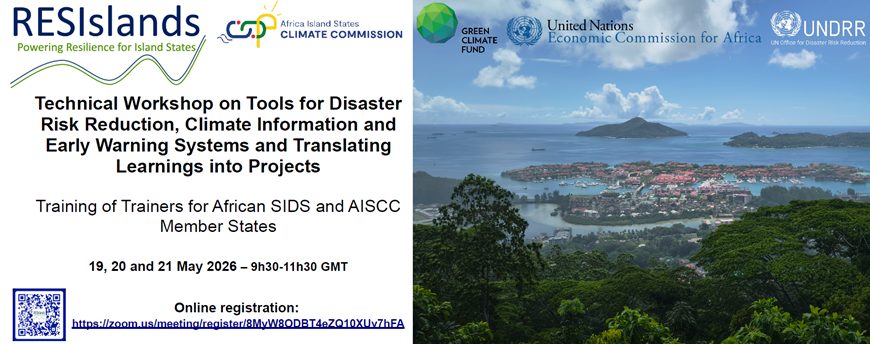
- Timeframe: 19-21 May 2026
- Objective: To introduce participants to disaster risk reduction concepts and tools, identify key gaps and needs in terms of regional and national capacity building for climate resilience, and discuss the contents of the Training of Trainers.
- Target audience: Government institutions of the AISCC member states involved in the RESIslands Project, including key Ministries such as Climate, Finance, Planning, Environment, Blue Economy, Health, DRR, Security, Energy, Infrastructure, Land development, and other specialized state agencies, such as National Designated Authorities (NDAs) of the target countries, Civil protection and Emergencies institutions, DRR and Hydromet institutions, and land use planning institutions. No restriction on the number of participants for the online session.
- Contents:
- Session 1: Project overview and country context
- Session 2: Key DRR concepts and themes (overview of loss and damage data, risk assessment, DRR planning, MHEWS needs and tools)
- Session 3: Discussion on project development needs and ToT contents
Document
Concept Note and Provisional Agenda