
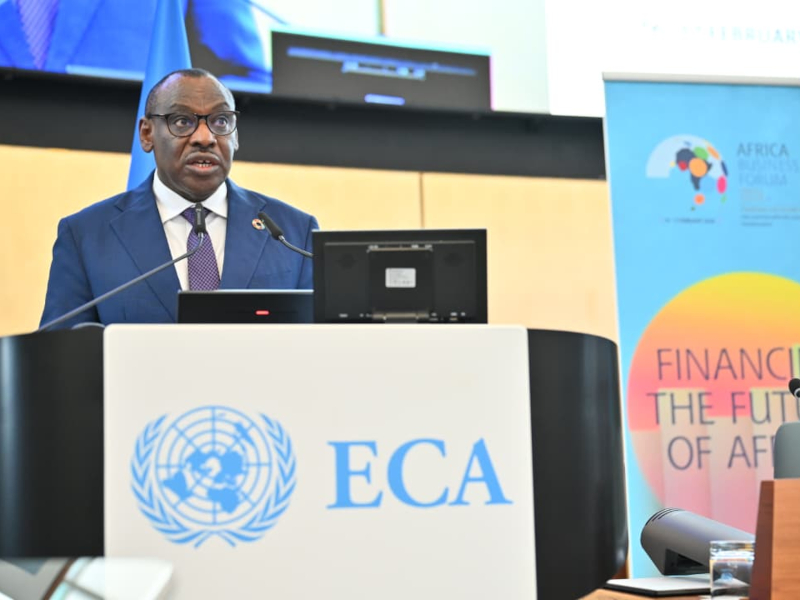
NINTH AFRICA BUSINESS FORUM
Theme:
“Financing the Future of Africa: Jobs and Innovation for Sustainable Transformation”
Statement
By
Mr. Claver Gatete
United Nations Under-Secretary-General and
Executive Secretary of ECA
16 February 2025,
Africa Hall, Addis Ababa, Ethiopia
H.E. Taye Atske Selassie, President of the Federal Democratic Republic of Ethiopia;
H.E Salah Ahmed Jama, Deputy Prime Minister of Somalia;
Honourable Ministers;
Esteemed Panelists;
Captains of industry & development finance leaders;
Innovators & our young entrepreneurs;
Distinguished guests;
Ladies and gentlemen:
It is an honour to welcome you to the Africa Business Forum convened by the Economic Commission for Africa under the theme: “Financing the Future of Africa: Jobs and Innovation for Sustainable Transformation.”
I wish to express my sincere appreciation to H.E. Taye Atske Selassie, President of the Federal Democratic Republic of Ethiopia, and the Government and people of Ethiopia for their gracious support and continued commitment to continental cooperation.
I also thank all our institutional partners for their continued devotion to Africa’s economic transformation.
Excellencies,
Distinguished Ladies and Gentlemen:
We meet at a moment of profound global uncertainty.
As we convene today, growth is slowing in many regions, debt vulnerabilities are rising and supply chains are being reorganized along geopolitical lines.
Climate shocks are disrupting production systems, while technological change is reshaping labour markets faster than policy responses can keep pace.
And yet, global capital has not disappeared. It has simply become more selective.
Investment now follows scale, security and future markets.
So, the question is not whether capital exists.
The real question is: where will the next engines of global growth emerge?
To answer that question, we must look not at today’s GDP size, but at tomorrow’s demand, workforce dynamics and market expansion.
Growth will emerge where the world’s youngest workforce lives, where urbanization is accelerating, where digital adoption is expanding and where new consumer markets are forming.
That place is Africa.
Africa is no longer a continent waiting for transformation; transformation is already underway.
Through the African Continental Free Trade Area, we are creating a single market of over 1.5 billion people.
Digital platforms are expanding and startup ecosystems are scaling.
This transformation is already visible in multiple sectors across the continent.
For example, in Côte d’Ivoire, a youth-led cocoa processing enterprise now processes 36,000 tons of cocoa annually and has created about 1,000 jobs.
In Morocco, an integrated automotive value chain created over 220,000 jobs.
And Ethiopia’s digital payments ecosystem engage hundreds of thousands of agents and merchants.
The narrative is therefore changing.
Africa is not only exporting commodities but beginning to export value, as well.
However, despite these successes, the pace of transformation remains below potential.
Africa faces a huge infrastructure financing gap and further loses billions annually to illicit financial flows.
Even so, the continent holds over US$1.1 trillion domestic institutional capital in pension funds, insurance pools and sovereign assets.
The paradox, therefore, is not a lack of capital, but the lack of mechanisms that connect capital to bankable projects.
The central question before this Forum is: how do we convert African opportunity into investable projects at scale and speed?
Distinguished Ladies and Gentlemen:
Every year millions of young Africans enter the labour market.
If they find productive employment, Africa becomes the growth frontier of the century.
If they do not, instability becomes globalized.
So, this is not merely an African development issue; it is a global economic stability issue.
What is missing is not commitment, but coordination and project preparation.
That is why this Forum is designed as a delivery platform – to connect investors to bankable projects and track commitments through implementation mechanisms.
The reorganisation of the global economy is also technological and ecological.
Green energy requires critical minerals. Digitalization requires data and skills. Resilient supply chains require diversification.
And Africa possesses all the three.
However, possessing resources alone is not the same as development.
Processing, trading and financing them is development.
This is where the development question becomes strategic.
Will Africa participate in the new global economy as a supplier of raw materials or as a competitive production platform?
If investment is to scale, the ecosystem enabling investment must also scale.
Allow me therefore to propose four strategic measures for our collective action.
First, we must scale domestic capital and deploy innovative financing instruments.
Digitised tax systems, broader tax bases and improved compliance can expand fiscal space.
In addition, pension funds, sovereign assets and blended finance can support infrastructure and industrial platforms.
Second, we need stronger credit ratings and more credible African capital markets.
Improving credit ratings, strengthening financial transparency and scaling up capital market development across the continent, can lower borrowing costs and channel investment into productive sectors and youth enterprises.
Third, we must fully implement the African Continental Free Trade Area.
As tariff and non-tariff barriers are removed, regional value chains can emerge, enabling large-scale production, industrialization and employment creation across the continent.
Fourth, we must invest decisively in innovation, skills and data systems.
The digital economy can generate millions of jobs, but only if we expand STEM education, research and development and entrepreneurial ecosystems, so that African youth can participate competitively in the industries of the future.
Excellencies,
Ladies and Gentlemen,
We now return to our opening question: where will global growth come from?
For decades, development debates focused on aid versus trade.
Today the real issue is risk perception versus investment reality.
Investors often ask whether Africa is ready for large‑scale capital.
But we should rather ask: can the world afford to ignore the largest emerging workforce and consumer market of this century?
The opportunity cost of not investing in Africa will soon exceed the risk of investing in it.
This Forum is therefore not only about Africa.
It is about the future structure of the global economy.
We can build industrial value chains, digital markets and green energy systems with Africa, or confront migration pressures, supply disruptions and instability without Africa.
The choice is collective. The responsibility is shared. And the moment is now.
The Economic Commission for Africa is as always ready, through policy analysis, convening power and implementation partnerships, to work with you to translate our commitments into measurable outcomes that will see jobs created, enterprises scaled and value chains financed.
I thank you and wish you a productive and impactful Forum.