Africa is entering a new demographic and financial phase in its development journey — one defined by the need to transform population growth into long-term economic resilience, domestic capital formation and sustainable economic transformation.
By 2050, Africa will account for more than 40% of global working-age population growth, representing nearly 600 million additional people entering the labour force. This demographic expansion presents a historic opportunity to build the world’s next major savings and consumption base. But turning this growth into a demographic dividend rather than a structural economic challenge will require social security systems capable of expanding coverage, mobilizing savings and supporting broad-based economic inclusion.
In this context, the future of Africa’s social security systems has become inseparable from the continent’s broader economic transformation agenda. Extending coverage to informal workers, leveraging digitization and financial technology, compliance, portability of benefits, universal health coverage and improving efficiency and governance will be critical to building inclusive, modern and financially sustainable systems adapted to Africa’s labour market realities.
At the same time, Africa is entering a new phase in its financing journey — one increasingly defined by the need to finance its own future. As external capital flows become more constrained and traditional development financing models evolve, the continent is turning toward its own institutional balance sheets, savings systems and domestic capital pools to anchor infrastructure development, industrialization and financial resilience.
Today, Africa’s pension funds, insurance institutions, sovereign funds and broader financial sector collectively represent more than US$4 trillion in domestic capital pools, including more than US$1 trillion held by pension and insurance institutions alone. Yet much of this capital remains concentrated in short-term instruments and government securities that often fail to deliver positive real returns in high-inflation environments, while limiting the availability of long-term financing for productive investment and infrastructure development to meet long term and matured future obligations.
Unlocking the full developmental potential of these capital pools will therefore require a new generation of financial intermediation mechanisms, guarantees and investment platforms capable of connecting African savings to Africa’s long-term development priorities. Achieving this at scale will require stronger cooperation, collaboration, coordination and harmonization across governments, regulators, social security institutions, development finance institutions and the private sector, particularly at a regional and cross-border level.
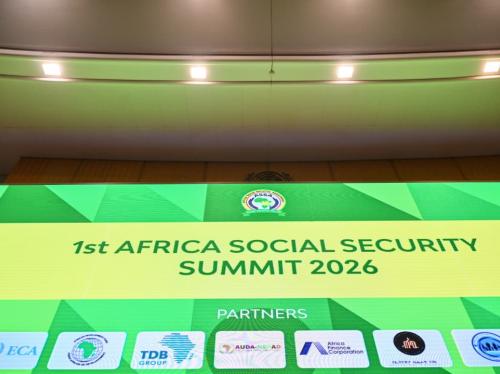
It is within this context that the Africa Social Security Association (ASSA) is convening its 1st African Continent Social Security Summit of the year 2026 on October 29th -30th under the theme:
“Harmonizing Social Security Systems for Infrastructure and Economic Transformation in Africa”
Held annually for many years, the ASSA Conference has established itself as a leading continental platform for dialogue among African social security institutions. In light of the continent’s evolving financing priorities and the growing alignment between social protection, investment and economic transformation agendas, the 2026 edition will be hosted for the first time in Addis Ababa, Ethiopia and in partnership with the African Union (AU), United Nations Economic Commission for Africa (ECA), African Development Bank (AfDB), AUDA-NEPAD, Africa Finance Corporation (AFC), Trade and Development Bank (TDB), National Bank of Ethiopia, Public Servants Social Security Agency (PSSSA) of Ethiopia and CRDB Bank PLC of Tanzania.
The first day of the Summit will focus on Africa’s evolving financing architecture and the role of social security institutions in mobilizing long-term capital for infrastructure, industrialization and economic transformation. The second day will adopt a more technical focus dedicated to the future of social security systems by sharing experience between themselves, including strategies to expand coverage to the informal sector, strengthen sustainability, improve governance and embrace digitization through data accuracy and technological innovation, universal health coverage and portability of benefits for migrant workers aimed to build more inclusive and modern social protection systems across Africa.
Documents
Related Albums