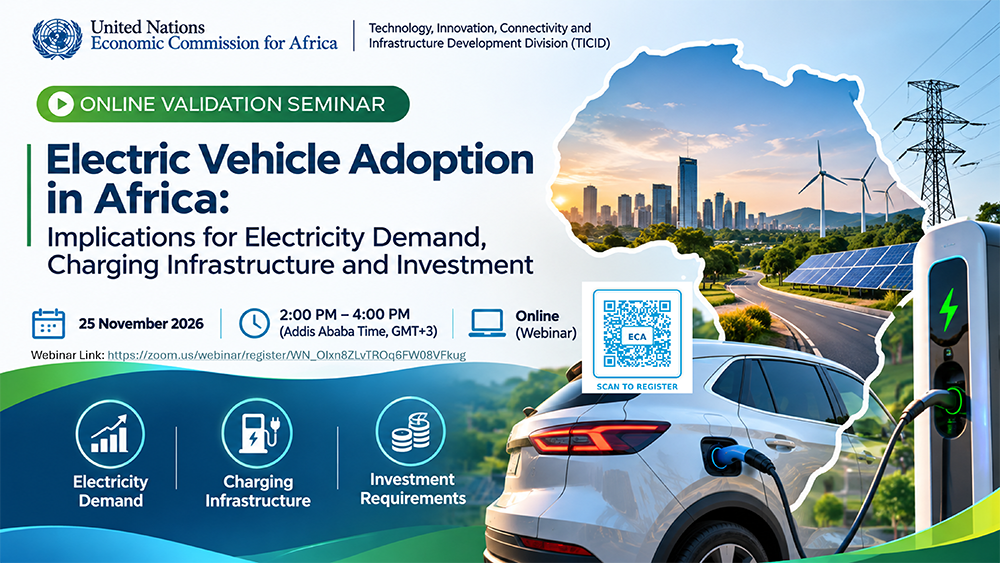
The webinar registration link : https://zoom.us/webinar/register/WN_OIxn8ZLvTROq6FW08VFkug
Electric mobility is gaining policy attention across Africa as countries seek to improve urban air quality, strengthen energy security and decarbonize transport. However, the pace of electric vehicle (EV) uptake and its implications for electricity systems, charging networks and financing remain uncertain. The Economic Commission for Africa (ECA), through its Technology, Innovation, Connectivity and Infrastructure Development Division (TICID), commissioned a study entitled ‘Electric Vehicle Adoption in Africa: Implications for Electricity Demand, Charging Infrastructure and Investment’. The draft technical report assesses alternative EV adoption pathways through 2050 across Africa and its five sub-regions, examining EV fleet growth, electricity demand, charging infrastructure, additional generation, grid reinforcement and investment requirements.
The seminar will provide a structured opportunity for technical experts and stakeholders to review and validate the draft report’s methodology, assumptions, scenario results and policy implications before finalization. It is intended to test the relevance, credibility and practical applicability of the analysis, rather than to endorse its findings in advance.
Objectives
-
Present the scope, modelling framework and principal findings of the draft study.
-
Obtain feedback on the Business-as-Usual, Moderate Electrification and Accelerated Electrification scenarios and underlying data assumptions.
-
Examine projected EV-related electricity demand, charging requirements, generation and grid implications, and investment estimates.
-
Assess differences across African sub-regions and transport segments and the relevance of proposed policy and financing responses.
-
Identify priority revisions, data gaps and recommendations for the final report.
Target Participants
The virtual seminar is intended for representatives of African government institutions responsible for energy, transport and infrastructure; electricity utilities and regulators; regional organizations; development partners and financial institutions; private-sector EV and charging-infrastructure actors; and researchers and technical experts. The session will combine a presentation of the draft report with moderated technical discussion and a closing synthesis of proposed revisions.