Background
The global response to climate change is entering a decisive phase in which the effectiveness of multilateral cooperation is being tested. In this context, it is no longer the number of climate-related pledges that matter, but rather the scale and speed of their implementation and resulting impacts. With the emissions gap widening, climate effects intensifying, and trust in international commitments under strain, upcoming Conferences of the Parties (COP) will play a critical role in determining whether the global climate regime can still deliver outcomes consistent with the 1.5°C goal, and the principles of equity and common but differentiated responsibilities.
Africa’s hosting of COP32 in Addis Ababa, Ethiopia, represents a moment of global consequence. COP32 to be held in late 2027 will indisputably take place at a time when the international community must demonstrate tangible progress on adaptation, loss and damage, climate finance, and implementation of Global Stocktake outcomes. The conference will therefore serve as a test of the credibility, relevance, and delivery capacity of the UNFCCC process itself. With extraordinary and coordinated leadership, COP32 can help reposition the global climate agenda around implementation, accountability, and resilience.
Overall Objective
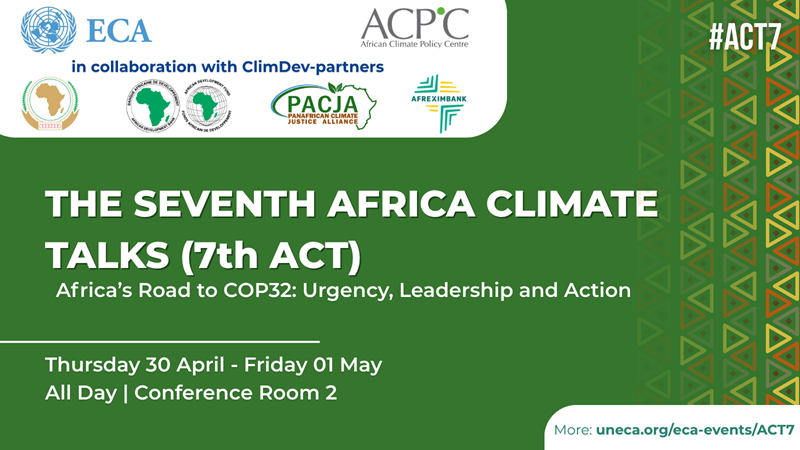
The overall objective of 7th ACTS is to consolidate Africa’s post-COP30 climate agenda and define a coordinated continental approach toward COP31/32 that is grounded in implementation, accountability, scientific integrity, equity, and structural transformation.
Specifically, the meeting seeks to:
- assess the implications of ACS2, CCDA-XIII and COP30 outcomes,
- evaluate the first Global Stocktake for Africa’s forthcoming NDC 3.0 cycle,
- discuss finance and adaptation priorities ahead of COP31/32,
- establish coherent frameworks for just transition and carbon market participation.
- reflect on the rapidly changing trade landscape and its challenges and opportunities for climate.
Expected Outputs
- A consolidated analytical brief assessing the implications of the Second Africa Climate Summit (ACS2), CCDA-XIII and COP30 outcomes for Africa’s strategic positioning in the UNFCCC process. This brief identifies alignment gaps, political opportunities, implementation risks, and priority negotiation tracks for coordinated African engagement.
- A technical note on the implications of the first Global Stocktake for Africa’s NDC 3.0 cycle. This output translates GST findings into actionable guidance for strengthening mitigation ambition, adaptation targets, resilience metrics, and means of implementation, while clarifying how African countries can leverage GST outcomes to reinforce equity and CBDR-RC arguments.
- A forward-looking Africa Finance and Adaptation Priorities ahead of COP32. This articulates quantified adaptation needs, define priority sectors, propose pathways for scaling finance (concessional and blended), and outline a coordinated African position on loss and damage, concessional finance reform, and access modalities.
- A guiding framework on Just Transition and Carbon Markets that ensue principles, safeguards, and governance benchmarks for Article 6 participation, define criteria for integrity and developmental co-benefits, and align carbon market engagement with industrialization, employment, and fiscal space objectives.
- A brief outlining challenges, opportunities and transformative ideas from an African lens to set the level of ambition for discussion and potential negotiation on the linkages between trade and climate at COP32.
Strategic Significance
7th ACTS is designed to reposition Africa from recipient of climate decisions to architect of climate implementation. By grounding discussions in scientific evidence, financial realism, institutional coordination, and development priorities, the meeting will demonstrate that Africa’s hosting of COP32 is not symbolic but strategic.
Documents and Speech
- Concept Note and Programme of Work [English]
- Opening Speech by H.E. Mr. Claver Gatete [English]
- Opening Speech by H.E. Mr. Berek Baran [English]
- Opening Speech by H.E. Moses Valakati [English]
Presentations
- How Can Africa Turn GST‑1 Outcomes into NDC 2025 Actions that Support Development Priorities? - Yaw Osafo
- Accelerating Climate Finance Solutions in Africa: Opportunities and Challenges
- Building Climate Resilience with the Urban Poor (BCRUP) Programme - Robert Sangori
- Article 6 of the Paris Agreement - Strengthening Africa’s Article 6 Participation with Integrity, Sovereignty and Trade Resilience : El Hadji Mbaye DIAGNE