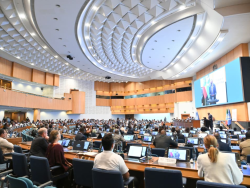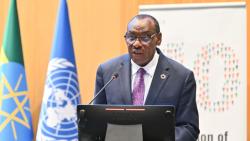
Douala, 23 October 2026 — The United Nations Economic Commission for Africa (ECA) has called for faster business climate reforms and investment in local processing to help Cameroonian firms compete in African markets under the African Continental Free Trade Area (AfCFTA). Jean Luc Mastaki Namegabe, Director of ECA’s Subregional Office for Central Africa, set out these priorities at the opening of the 12th Cameroon Business Forum (CBF), held in Douala on 22 and 23 October 2026.
Chaired by Prime Minister Joseph Dion Ngute, the forum resumed after a six-year hiatus, amid high private sector expectations for progress on reform implementation. Its theme, “AfCFTA and productive transformation: what reforms will make Cameroon a major industrial and trade hub in Africa?”, focused the dialogue on industrial development and expansion into markets across the continent.
The Prime Minister linked these efforts to Cameroon’s National Development Strategy 2020–2030 (SND30) and the strengthening of its import-substitution policy. “Our businesses, through their competitiveness, will turn these opportunities into wealth and jobs,” he said, highlighting the potential of larger markets to generate economies of scale.
ECA projections presented at the forum show that implementing AfCFTA could increase intra-African trade by 45% by 2045. For Cameroon, ECA recommended supporting industries with a comparative advantage, including agro-processing, processed wood products, pharmaceuticals and construction materials, and strengthening their integration into African value chains. Processing timber into furniture for regional export markets was cited as one way to generate more value at home.
Delivering on these industrial ambitions will require addressing the constraints facing businesses. According to business surveys cited by the Cameroon Chamber of Commerce, Industry, Mines and Crafts (CCIMA), 66% of firms surveyed reported rising supplier prices, 63.5% cited the tax burden and 45% highlighted high energy costs. These pressures squeeze margins and limit firms’ capacity to invest.
ECA recommended accelerating business climate reforms and developing trade infrastructure. The Prime Minister also identified lower production and transaction costs, simpler procedures and more efficient trade corridors as prerequisites for taking full advantage of the continental market.
Célestin Tawamba, president of Cameroon’s employers’ association GECAM, highlighted challenges relating to electricity supply, roads and legal certainty for businesses. He called for a public timetable for clearing government payment arrears and for VAT refunds within statutory deadlines to restore business cash flow. “Our businesses are ready to play their full part,” he said. CCIMA, meanwhile, called for long-term credit for productive investment, greater legal certainty and stronger judicial safeguards for investment.
ECA recommended establishing clear national requirements for the “Made in Cameroon” label, backed by credible quality assurance and certification systems. Understanding and complying with rules of origin is equally important, since these determine whether products qualify for preferential tariffs. Businesses must therefore identify target markets, meet applicable standards and strengthen their export capabilities. “AfCFTA does not automatically open markets. Competitive businesses will be the ones to win them,” Mastaki said in his presentation.
Reliable information on trade procedures is also essential. To address complex requirements and information scattered across government agencies, ECA supported the development of a step-by-step guide to trading goods under AfCFTA and a national trade information portal. Both were validated in Douala in August 2026. These tools aim to clarify procedures and reduce the time and cost of finding information, particularly for small and medium-sized enterprises (SMEs) and businesses led by women or young people. They build on ECA’s support for Cameroon’s national AfCFTA implementation strategy and capacity-building for public and private sector stakeholders.
The forum’s return has put implementation at the heart of public–private dialogue. Tawamba called for “around ten recommendations, each with a designated lead, a deadline and a performance indicator, and a public review of progress in six months”. He said the aim was to make the CBF “a forum for accountability, rather than just a place for discussion”.
Christophe Eken, president of CCIMA, reaffirmed business organizations’ willingness to contribute to this effort. “The private sector wants to be a full partner with government, from identifying constraints to developing solutions and monitoring reforms,” he said.
The Prime Minister called for practical, actionable recommendations with clear responsibilities and deadlines. “I will personally ensure rigorous follow-up on the recommendations that are adopted,” he said, announcing that an update on implementation would be presented at the next session.
Queries
Zacharie Roger MBARGA - Communications Officer
United Nations Economic Commission for Africa
637, rue 3.069, Quartier du Lac, Yaoundé, Cameroon
Tel: (+237) 222504348
E-mail: zacharie.mbargayene@un.org
Issued by:
Communications Section
Economic Commission for Africa
PO Box 3001
Addis Ababa
Ethiopia
Tel: +251 11 551 5826
E-mail: eca-info@un.org