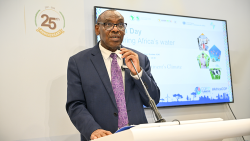
Antalya, Türkiye, 16 November 2026 (ECA) – Claver Gatete, United Nations Under-Secretary-General and Executive Secretary of the Economic Commission for Africa (ECA), urged greater access to affordable climate finance, stronger domestic resource mobilization and increased investment in projects supporting Africa’s economic growth and climate resilience.
During the first week of COP31, described by its Presidency as an “implementation COP”, Mr Gatete addressed sessions on climate finance, industrialization, regional electricity networks, disaster preparedness and food security.
He stressed that delivering on climate commitments requires sustained financing, clear institutional responsibilities and measurable results.
A 2025 assessment by the Council on Energy, Environment and Water (CEEW) found that only 28 per cent of 203 cooperative climate initiatives launched since the Paris Agreement had dedicated budgets.
Citing the findings, Mr Gatete said: “Initiatives need a home beyond the COP Presidency that launched them.”
He also highlighted the Climate Implementation Bridge, with Ethiopia among its pilot countries, as a mechanism to help countries develop projects capable of attracting investment.
Africa needs an estimated US$277 billion annually to implement its nationally determined contributions through 2030, but current climate finance flows meet only about 11 per cent of that requirement.
Mr Gatete warned that high borrowing costs drain resources from essential services and development.
“Climate financing must ease these pressures rather than deepen them, while supporting investment in resilience, energy access and economic growth,” he said.
He urged greater access to grants and concessional finance, simpler procedures for accessing climate funds and better preparation of investment projects. He also emphasized the role of African development finance institutions in mobilizing domestic resources and private capital.
On credit risk assessments, he welcomed the launch of the Africa Credit Rating Agency (AfCRA), an independent, private sector-driven institution, as a step towards improving assessments of African economies and investment risks.
But better ratings alone, he cautioned, would not be enough without sound economic policies, stronger institutions and credible investment projects.
The ECA chief also emphasized stronger regional power pools and cross-border electricity connections to improve access to reliable electricity, facilitate electricity trade and support industrial development.
He warned that climate-related disasters weaken productivity, disrupt trade, deter investment and increase debt burdens.
“Resilience must therefore be seen as an investment, not a cost,” he said.
Addressing a session on early warning systems, he commended Mozambique’s President Daniel Chapo, the African Union Champion for Disaster Risk Management, for his leadership and stressed the need to strengthen Africa’s early warning capabilities.
Forty-one African countries now report on early warning systems, but gaps remain in forecasting infrastructure, communication with vulnerable communities and sustainable financing.
At a separate discussion on food security in the Sahel, Mr Gatete noted that agriculture accounts for about 30 per cent of the region’s GDP and provides livelihoods for more than 60 per cent of its people. Yet erratic rainfall, severe droughts, inadequate infrastructure and barriers to trade constrain the sector.
He urged anticipatory financing so governments can act before climate shocks disrupt food production and livelihoods, alongside investment in climate-resilient agriculture, storage and processing, regional agricultural value chains and shock-responsive social protection.
Mr Gatete also held several bilateral meetings with government leaders, development partners and private sector executives to discuss Africa’s climate and development priorities, including opportunities for stronger cooperation and investment.
Among these engagements was a meeting with Nana Antwi-Boasiako Amoah, Chair of the African Group of Negotiators (AGN), as COP31’s first week drew to a close. Mr Amoah briefed him on the negotiations and Africa’s priorities and thanked ECA for its technical support. Mr Gatete reaffirmed the Commission’s commitment to supporting African negotiators.
At a press conference on 10 November, Mr Amoah said the AGN sought a clear baseline and funding trajectory for implementing the COP30 goal of at least tripling adaptation finance by 2035.
A 2025 report by the Global Center on Adaptation and Climate Policy Initiative estimates Africa’s annual adaptation needs at least US$70 billion, while tracked adaptation finance reached only US$14.8 billion in 2023.
With Ethiopia set to host COP32 in Addis Ababa next year, Prime Minister Abiy Ahmed has identified early action and clearer climate finance commitments as priorities. In his COP31 statement, he set out three questions that financing pledges should answer: “How much? By when? On what terms?”
Issued by:
Communications Section
Economic Commission for Africa
PO Box 3001
Addis Ababa
Ethiopia
Tel: +251 11 551 5826
E-mail: eca-info@un.org