
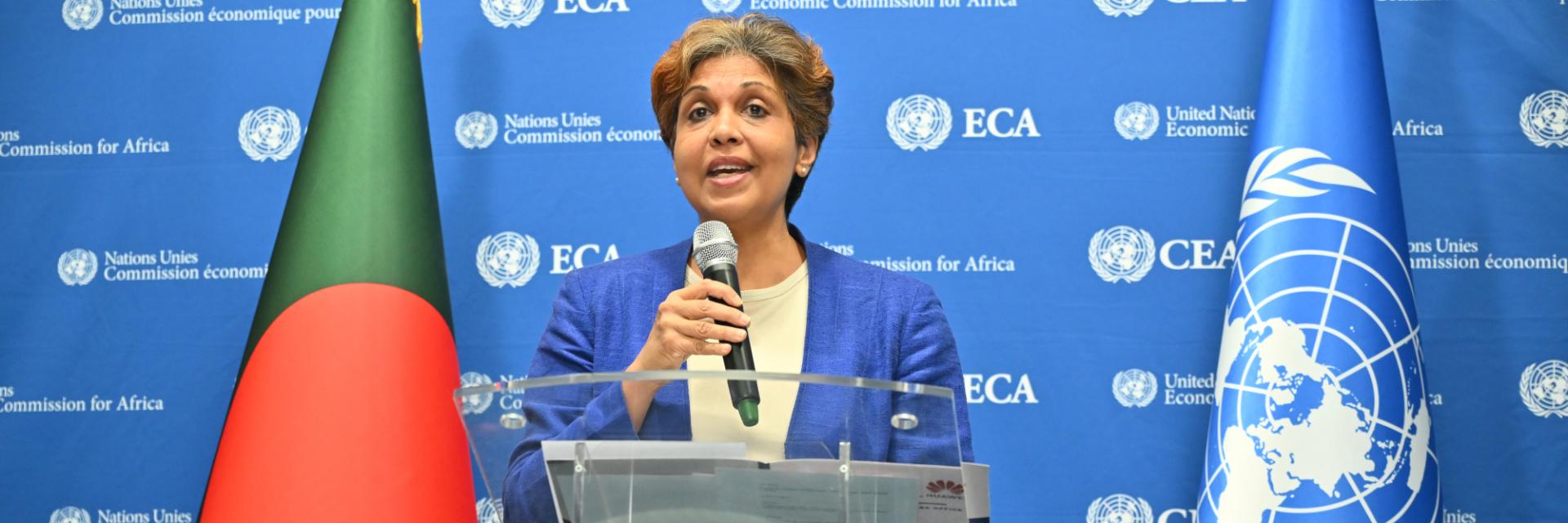
International Mother Language Day
25 February 2026, Addis.Ababa
Excellencies, Distinguished Ambassadors,
Honored Representatives of Partner Organizations,
Dear Guests, Friends of Linguistic Diversity, Ladies and Gentlemen,
Very happy to join this commemoration of International Mother Language Day. This is more than a date on the calendar; it is a celebration of who we are. We gather today to recognize a simple, powerful truth: our languages are far more than tools for communication. They are the living guardians of our identity, the vessels of our culture, and the very lens through which we view the world.
Since its proclamation by UNESCO in 1999, this day has served as a vital global reminder. It reminds us that within each language lies the accumulated wisdom of generations, our stories, our values, our beliefs, and our dreams. Our mother tongue is the language of our first lullaby, the language of our earliest memories. It is how we understand our past and how we envision our future.
Today, we come together to affirm, loudly and clearly, that linguistic diversity is not an obstacle to unity, but a fundamental pillar of peaceful, inclusive, and sustainable societies. As UNESCO has consistently emphasized, promoting multilingualism is a key instrument for fostering lasting peace, tolerance, and mutual respect between peoples.
Each language is a unique and irreplaceable source of human creativity and knowledge. Yet, this source is under threat. Across the globe, languages are disappearing at an alarming rate. With each one that falls silent, we lose an entire world of meaning, an invaluable piece of our shared human heritage.
Currently, over 8,000 languages are spoken or signed worldwide. But many remain marginalized, excluded from education, public life, and the digital spaces that define our modern era. As the Director-General of UNESCO has powerfully stated, “A language is far more than a means of communication; it is the very condition of our humanity.” This diversity of tongues is not a barrier; it is a testament to the irreducible richness of human imagination and our countless ways of life.
Here, in the African region, the cradle of humanity and a land of exceptional linguistic wealth, this truth resonates deeply. Our mother languages are a living heritage, an unbreakable link between generations, and a powerful vector for social cohesion. They are our repositories of memory, the wellsprings of our cultural innovation, and the bridges to a shared and prosperous future.
However, let us be clear-eyed about the challenge. We know that approximately 40% of the global population does not have access to education in a language they speak or understand. This single fact limits a child's ability to learn, to succeed, and to contribute fully to their community and society. This is why promoting mother tongue-based multilingual education is not just a cultural imperative; it is a matter of justice, equity, and a cornerstone of sustainable development.
Therefore, on this day, UNESCO reaffirms its commitment to work hand-in-hand with governments, educational authorities, local communities, teachers, and, most importantly, our youth, to turn commitment into concrete action.
We call upon all stakeholders to join us in a collective effort to:
-
Ensure every child has the fundamental right to learn in a language they understand and value.
-
Place linguistic diversity at the very heart of our educational, cultural, and digital policies.
-
Strengthen the institutional frameworks that protect, revitalize, and promote all languages, especially those of minorities and indigenous peoples.
On this solemn and celebratory day, let us remember that our languages are irreplaceable human treasures. They are living legacies that we have a sacred obligation to nurture and pass on to our children, our communities, and all future generations. They are central to our ability to learn, to engage in meaningful dialogue, and to live together in peace, enriched by all our diversity.
So today, let us answer the call to action. Let us commit to:
-
Integrate mother tongues at every level of our educational systems.
-
Support public policies that solidify the role of local languages in civic and cultural life.
-
Encourage the creation of inclusive digital content and language technologies that embrace our youth and leave no one behind.
Let us stand together and celebrate the immeasurable richness of our mother languages. Let us celebrate the diversity that enriches us, unites us, and inspires us. And let us pledge to build a world where every language has its rightful place, where every voice is not only heard but celebrated, and where no child grows up in silence, alienated from their own linguistic heritage.
Thank you.