
![[Blog] Why the next four years are crucial for north Africa’s Small and Medium-Sized Enterprises](https://www.uneca.org/sites/default/files/styles/slider_image/public/storyimages/shutterstock_2624257335-2000x667.jpg?itok=R5p0rbLi)
Authors: Wafa Aidi, and Oumaima Tounchibine
North Africa is at a crossroads. In the coming decades, a large share of its population will reach working age, offering a major demographic opportunity. Realizing this potential will require creating enough jobs. SMEs—representing 80–90% of formal firms and about half of formal employment—are key to this effort and, with stronger development programs, could drive more inclusive growth.
The Untapped Potential
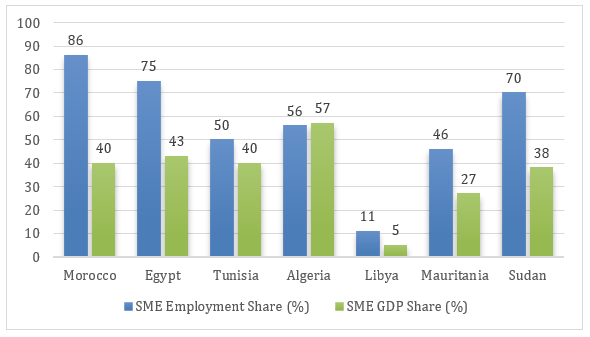
The data presented in the figure below reveals both strong potential and persistent challenges across countries. Morocco leads in SMEs' socio-economic contribution, with SMEs accounting for about 86% of employment and 40% of GDP, underscoring their central role in driving job creation and economic activities. Tunisia and Egypt also show strong participation (50–75% of employment, 40–43% of GDP), reflecting supportive entrepreneurial ecosystems. In contrast, SMEs in Libya, Mauritania, and Sudan contribute only 5–11% to GDP, revealing significant untapped potential and pointing to structural constraints that hinder private-sector development. Key barriers include financing gaps, regulatory burdens, low digital adoption, weak managerial capacity, and limited preparedness for climate risks (World Bank, 2024[1]).
Figure 1: SME employment and GDP contributions in North African countries[2]
ECA based on various data sources
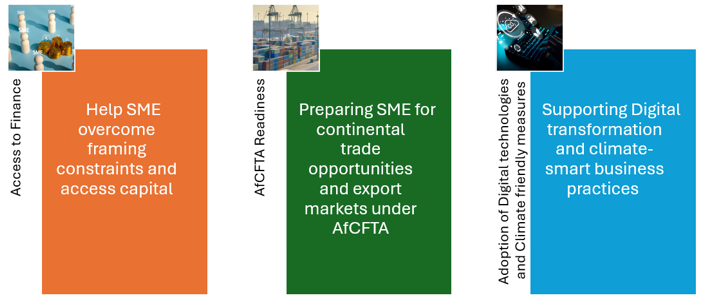
Revitalizing North Africa’s SMEs: The Three A’s Framework (Access to Finance, AfCFTA, Adoption of digital technologies and Climate adaptation measures)
Three developmental levers could reshape the SME landscape in North Africa. First, access to finance should be improved through enhanced accessibility, affordability and de-risking policies. Second, the African Continental Free Trade Area (AfCFTA) gives SMEs access to a market of 1.4 billion consumers, with intra-African trade projected to grow by up to 45% by 2045 and particularly strong gains in agrifood (60 percent increase), industry (48 percent), and services (34 percent). Third, accelerating digitalization—Africa’s digital economy could reach $712 billion by 2050, making digital tools and e-commerce essential for market access and value chain integration. In the same vein, acceleratingclimate adaptation offers SMEs that integrate environmental, social, and governance standards into their operations opportunities improved access to climate finance and position themselves for long-term sustainability in a region particularly vulnerable to heatwaves, droughts, and water stress.
Figure 2: The 3 A’s Framework for SME Development in North Africa
ECA, 2026
Recommendations: Evidence and Policy Imperatives
The United Nations Economic Commission for Africa’s SME initiative (2023–2025) in Libya, Mauritania, Morocco, and Tunisia shows the impact of targeted support. Based on the “3 A’s framework”—Access to finance, AfCFTA readiness, and Adoption of digital and climate practices—the program supports women- and youth-led SMEs. Evaluations show significant improvement in business and managerial skills. In Mauritania, SMEs increased knowledge scores by 10.55 points, with major gains in business planning and export readiness. Tunisian SMEs nearly doubled their export readiness, from 34.6% to about 66%, while Libyan SMEs significantly improved their knowledge of sustainability practices. Moreover, the program directly informed national policy processes: feeding into Mauritania's national SME development strategy, underpinning Tunisia's upcoming 2026,2030 SME Development Strategy, and supporting Libya's economic diversification efforts.
The convergence of a growing demographic dividend, AfCFTA opportunities, and rapid digitalization is creating strong momentum in North Africa. With the next four years critical for advancing the Sustainable Development Goals, SMEs will play a key role in job creation and inclusive growth. Well-designed support programs—improving access to finance, strengthening AfCFTA readiness, promoting digital adoption, and integrating climate considerations—can enhance SME productivity, regional integration and resilience.
[1] World Bank. (2024). SME Finance. Washington, DC: World Bank Group. https://www.worldbank.org/en/topic/smefinance
[2] Last available data are reported, Algeria (AfDB 2018 for GDP and Review of developments and prospects for research Libya (OECD, 2016), Egypt (Micro, Small and Medium Entreprises, 2024), Mauritania ( Chikh and Yacoub, 2021 “Les PME-PMI en Mauritanie : Etat de lieu, contribution, contraintes et perspectives SMEs and SMIs in Mauritania: Status, contribution, constraints and prospects”, El Behith Review Vol 21), Morocco (Report High-Level Policy Dialogue on SMEs, 2024 and Ministry of Economy and Finance, 2023), Tunisia (National Statistical Institute, 2018) and Sudan( Elsheikh Abdelrahman, Bt Abdullah, Aba (2017) “Conceptual Model of Predictors of SMEs’ Performance in the Context of Sudan”, Journal of Business and Social Review in Emerging Economies, Vol.3)