
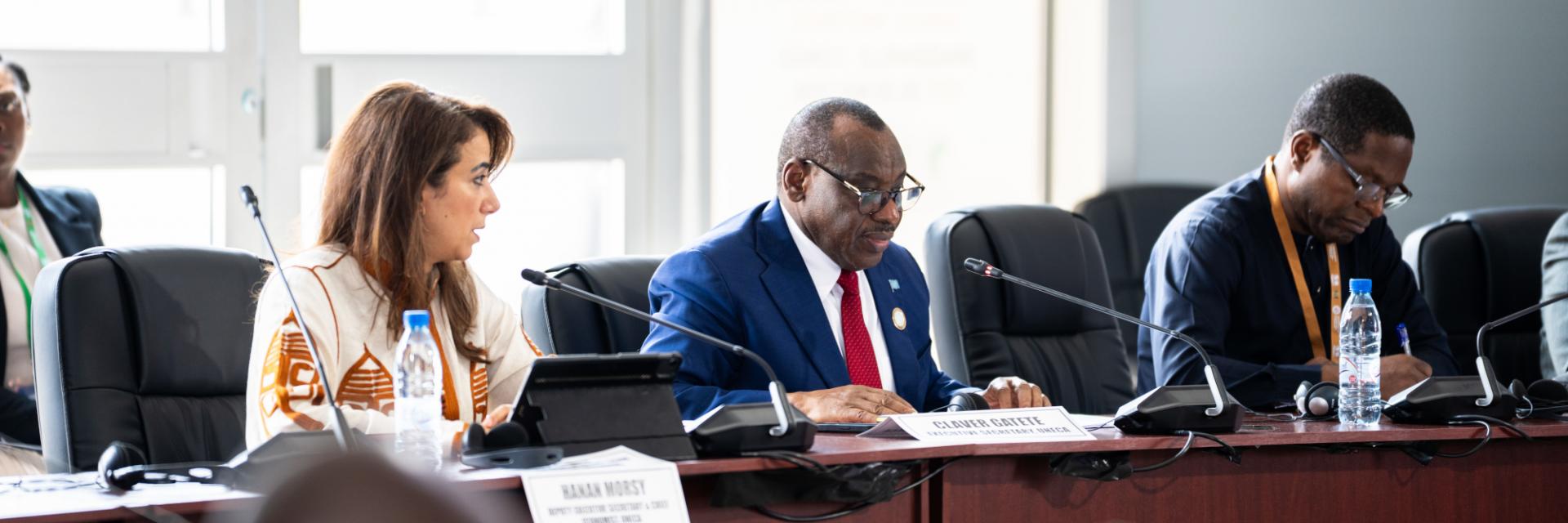
Welcome Remarks
By ES Claver Gatete
Meeting of the Africa High-level Working Group
on the Global Financial Architecture
Brazzaville, The Republic of Congo
25 May 2026
Welcome Remarks (5 min)
Excellencies,
Distinguished delegates,
Please allow me to welcome all of you to this meeting of the Africa High-level Working Group on the Global Financial Architecture. It is a privilege to convene with you today as we continue our critical deliberations on the structural shifts shaping our economies. It is great to see so many of you here in person in Brazzaville, and I would also like to greet everyone who is joining us virtually.
Excellencies,
When we gathered last month in Washington DC during IMF - World Bank Spring Meetings, we confronted the global developments facing Africa, their implications for our economies, and the key reforms that we should take forward with the IMF, the World Bank, and regional development finance institutions.
We agreed that Africa is operating in a new normal of lower growth and higher uncertainty. Financing conditions have tightened, and the cost of capital has reset upward. Concessional space is shrinking.
In that context, we emphasized the need for urgent crisis response, but also for long-term structural reform.
Today’s discussion on the Carbon Border Adjustment Mechanism, or CBAM, comes at a pivotal moment. While CBAM is presented as a climate policy instrument, we must analyze it through a broader structural lens. For Africa, this is not merely an environmental directive; it is fundamentally a trade, industrialization, and development issue. If the current design and pace of implementation are not carefully calibrated, CBAM risks stoking trade tensions, fueling economic fragmentation, and exacerbating global inequality, all while delivering limited climate benefits.
As CBAM transitions toward full implementation, African exporters will confront substantial new carbon levies and stringent compliance obligations. The sectors currently covered (including cement, iron and steel, aluminum, fertilizers, electricity, and hydrogen) are not marginal sectors. They are central to Africa’s industrialization, infrastructure development, energy transition, and regional value chains.
The challenge is not only the carbon price itself. It is also the ability to measure, report, and verify embedded emissions, access clean technologies, build credible regulatory systems, and mobilize the finance needed to adapt. Without adequate support and transition time, CBAM could become less an incentive for low-carbon development, and more a new barrier to market access. This is why Africa’s response must be evidence-based, coordinated, and anchored in fairness, partnership, and shared but differentiated responsibilities.
Excellencies,
In today’s meeting, DES Hanan Morsy and Mr. Melaku Desta, from our Regional Integration and Trade Division, will present ECA analytical work on the “Impact of EU CBAM on Africa”.
Finally, I once again welcome all of you to the meeting, and look forward to a frank, practical, and insightful discussion on how Africa can respond to CBAM in a way that protects our economies, supports our industrialization, and advances a just transition.
Thank you.