
2026 HIGH-LEVEL POLITICAL FORUM (HLPF)
AFRICA DAY
Launch of the 2026 Africa Sustainable Development Report
Statement
By
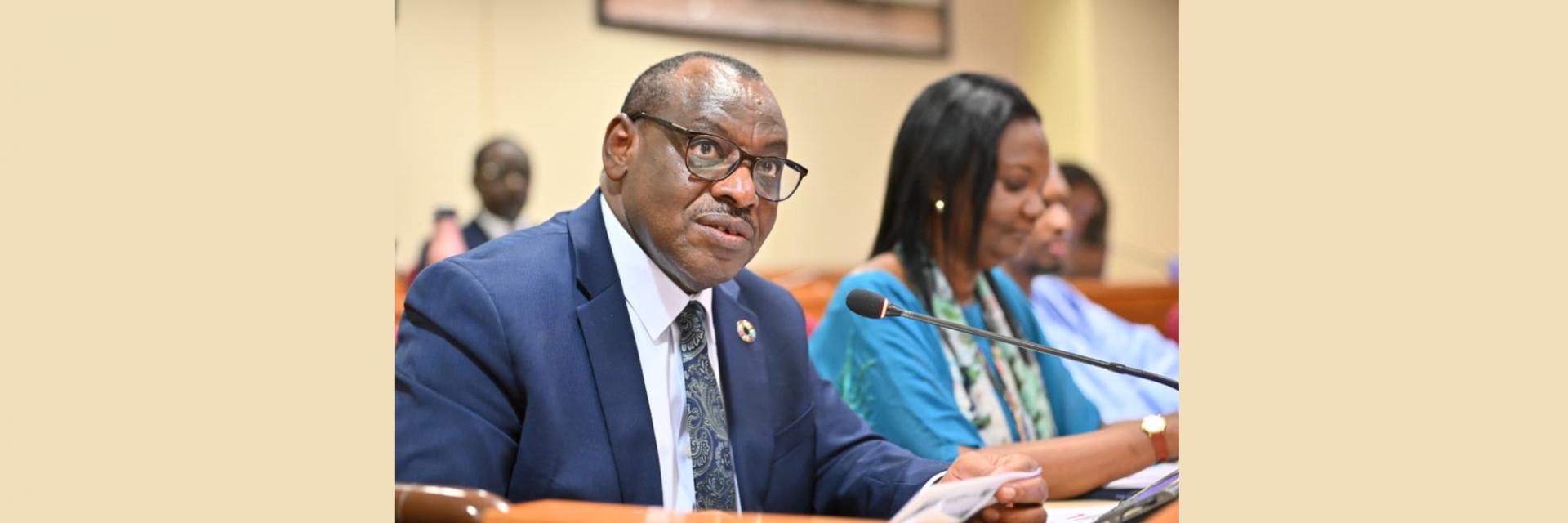
Mr. Claver Gatete
United Nations Under-Secretary-General and
Executive Secretary of ECA
New York
14 July 2026
Excellencies,
Ms. Amina Mohammed, Deputy Secretary-General of the United Nations,
Mr Åsmund Grøver Aukrust, Minister of International Development, Norway,
Prof Imraan Valodia, member of the Founding Committee for International Panel on Inequality,
Ministers, Ambassadors,
Distinguished Delegates,
Ladies and Gentlemen:
Permit me to stand on established protocol.
It is a privilege to join you today for Africa Day at the High-Level Political Forum and for the launch of the 2026 Africa Sustainable Development Report – a report that comes at a defining moment for Africa and the world.
The global context in which we meet is both sobering and demanding.
Less than five years remain to achieve the Sustainable Development Goals, yet the world is confronting a convergence of crises: geopolitical tensions, rising debt burdens, climate shocks, slowing growth, declining development assistance and widening financing gaps.
The global SDG financing gap has now reached approximately US$4 trillion annually for developing countries.
The instability in the Middle East has further intensified uncertainty, disrupting trade routes, increasing energy and food price volatility, and placing additional pressure on developing economies, including those in Africa.
Recent UN assessments warn that these disruptions are amplifying inflationary pressures and raising borrowing costs precisely when many countries can least afford them.
And yet, despite these formidable headwinds, Africa is not retreating; it is adapting, innovating and moving forward.
A few months ago, leaders gathered in Addis Ababa under the theme: “Turning the Tide: Transformative and Coordinated Actions for the 2030 Agenda and Agenda 2063.”
The message was unequivocal: Africa is determined not merely to manage crises but to drive transformation.
The 2026 Africa Sustainable Development Report confirms that Africa has made significant strides.
We see that progress echoed in the 19 African countries presenting Voluntary National Reviews at this High-level Political Forum.
Their experiences inform us that, even in the midst of multiple global shocks, Africa continues to advance.
They also reinforce a clear message: the time for delivery is now.
And indeed, across the continent, tangible gains are visible in infrastructure development, digital innovation, renewable energy expansion, regional integration and access to services.
But the report also delivers a candid message: progress is not fast enough.
Financing constraints, infrastructure deficits, climate impacts, conflicts and debt-service pressures continue to slow implementation.
The gap we must now close is not an ambition gap, but an execution gap.
Because what good are commitments if they do not change lives?
What value is a target if it does not create jobs for a young woman in Lagos, connect a farmer in Malawi to markets, or provide clean water to a family in the Sahel?
The imperative therefore is to transform our plans into policies and action, leading to tangible results for our people.
Fortunately, Africa enters this next phase with one extraordinary advantage.
Today, Africa is home to more than 1.5 billion people.
By 2050, our population is expected to reach 2.5 billion, and more than one-quarter of humanity will be African.
By 2035, more young Africans will enter the labour market every year than in the rest of the world combined.
This is one of the greatest opportunities of the twenty-first century.
But demographics alone will not create the prosperity Africa seeks.
The question is: will we transform this demographic growth into an economic dividend?
Or will we allow opportunity to become vulnerability?
The answer depends on the choices we make and the actions we take today.
First, we must strengthen implementation capacity.
Strong institutions, reliable data systems and accountable governance remain essential to delivering results at scale.
Second, we must mobilize the resources needed to close the financing gap.
The Sevilla Commitment provides renewed momentum for debt sustainability, domestic resource mobilization, and reform of the international financial architecture.
Africa must continue to advocate for a system that lowers the cost of capital and recognizes our development realities.
Third, we must accelerate regional integration through the African Continental Free Trade Area.
A fragmented Africa cannot industrialize at the pace required; a connected Africa can become a global growth pole.
Fourth, we must harness technology and innovation.
Artificial intelligence, digital public infrastructure, frontier technologies, and modern data systems can accelerate progress across multiple SDGs simultaneously.
Africa has the potential not merely to adopt technology but to shape its future applications.
Fifth, we must place climate resilience at the centre of development planning.
This is why Africa welcomes Ethiopia’s selection to host COP32 in Addis Ababa in 2027.
The COP represents a generational opportunity for Africa to elevate its priorities on climate finance, adaptation, green industrialization and sustainable growth.
As such, the road to Addis Ababa must be the road toward implementation.
Ladies and Gentlemen,
The central message of the 2026 Africa Sustainable Development Report is ultimately one of possibility.
Africa possesses the world’s youngest population.
It has the world’s largest free trade area. It holds enormous renewable energy potential.
And it has demonstrated resilience in the face of repeated shocks.
So, we know Africa can achieve transformation.
What remains is whether we can move with the speed, scale and coordination required.
Meeting that challenge will require capable institutions and committed partners. That is precisely where the United Nations Economic Commission for Africa will continue to stand with our member States.
We remain committed to supporting member States by advancing domestic resource mobilization, implementing the African Continental Free Trade Area, promoting sustainable industrialization, strengthening data systems and improving evidence-based policymaking.
Together, we can work to ensure that this report becomes a blueprint for delivery – one that accelerates implementation, unlocks financing, forges stronger partnerships and ensures that Africa contributes not only to achieving the SDGs and Agenda 2063, but to shaping the future architecture of global development itself.
I thank you.