Share this:
Opportunities and challenges for blue growth
Release Date:
28 October, 2025
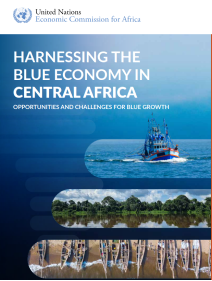
Central Africa has vast and diverse, although largely untapped, aquatic resources. The subregion is at a crossroads: it can either harness the transformative potential of the blue economy or risk further ecosystem degradation. The blue economy refers to the sustainable use, management and conservation of all natural water ecosystems, including oceans, coasts, lakes, rivers and groundwater, and their supported economic activities and ecosystem services. Integrating economic, social and environmental sustainability, the concept promotes inclusive growth across coastal, island and landlocked States (United Nations, ECA, 2016). As opposed to siloed, uncoordinated, sector-specific approaches, the blue economy applies an ecosystem-based perspective that minimizes sectoral barriers to reflect the uninhibited flow of water within interdependent ecosystems.
This report evaluates the current state of the blue economy in the Economic Community of Central African States (ECCAS) across its 11 member States: Angola, Burundi, Cameroon, Central African Republic, Chad, Congo, Democratic Republic of the Congo, Equatorial Guinea, Gabon, Rwanda and Sao Tome and Principe. Major opportunities and critical challenges are identified, and recommendations are made for policymakers, development partners and other stakeholders. In the absence of a comprehensive evaluation of the whole of the blue economy, the present report includes an analysis of the state of the sectors that are prioritized in the ECCAS blue economy strategy: fisheries and aquaculture, shipping and maritime transport, coastal and marine tourism, and sustainable energy and mineral resources.