![[Blog] Water, sanitation, and women’s economic empowerment across the lifecycle in Africa](https://www.uneca.org/sites/default/files/styles/slider_image/public/storyimages/shutterstock_2037622259_1920x640.jpg?itok=PnRBMmC9)
By Zuzana SCHWIDROWSKI and Omolola Mary Lipede
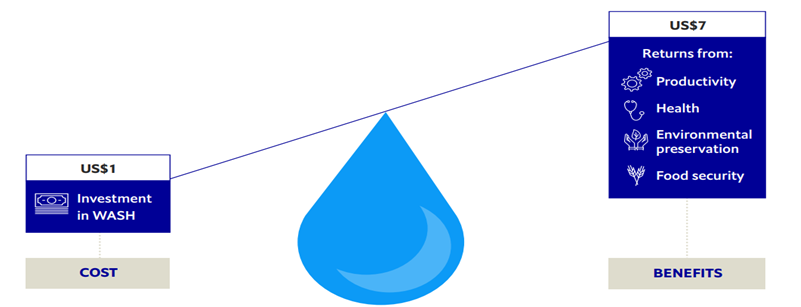
Water, sanitation, and hygiene (WASH) are often viewed primarily as matters of health and human rights. Yet they are a key economic issue - one that shapes women’s productivity, labor market participation, and lifetime earnings. Across the lifecycle, inadequate WASH services impose particularly high costs on girls and women. In contrast, gender-responsive WASH investments deliver high social and economic returns for individuals, households, and national economies through productivity gains, reduced health care costs, and time savings (Figure 1 and WaterAid, 2024).[i] In Africa, pronounced gaps in WASH infrastructure combined with gender norms, constrain women’s economic agency from childhood through adulthood.
Figure 1. Economic returns to investments in water, sanitation and hygiene
Source: AUC, the International High-Level Panel on Water Investments for Africa (2024).
This blog examines the economic implications of women’s WASH access through a lifecycle perspective, focusing on how constraints in childhood, adulthood, and motherhood shape women’s economic opportunities.
Barriers to women’s economic empowerment start in childhood
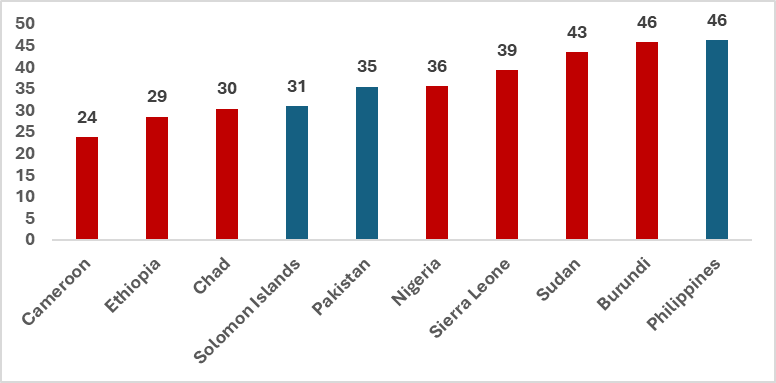
For girls in Africa, access to safe water and sanitation, particularly in schools, is a decisive factor in educational attainment. However, in Africa, access to such facilities cannot be taken for granted. While in some middle-income countries, notably Mauritius and Seychelles, more than 99% of schools provide access to basic water services, in several low-income countries such access is below 50%. Moreover, among ten countries with the lowest shares of schools with access to basic water services globally, seven are in Africa (Figure 2). The limited access to private, functional sanitation facilities contributes to girls’ school absenteeism and lifts their dropout rates. Such educational disruptions reduce skills acquisition, weaken chances of women to find decent jobs, and ultimately lower their lifetime earnings, undermining the returns on investments in education.
Figure 2. Countries with the lowest access to basic water services in schools
(% of schools with access to basic water services)
Source: UNICEF database: https://data.unicef.org/topic/water-and-sanitation/drinking-water/
From a labor market perspective, better WASH access can strengthen the quality of labor supply. Across Africa and other developing regions, women and girls collectively spend an estimated 200 million hours every day collecting water. When girls and young women spend fewer hours collecting water and have access to safe sanitation in schools, they are more likely to attend school regularly, complete more years of education, and enter the labor market with stronger skills (UNICEF&WHO, 2018).[i] Cross-country data also suggest a positive association between access to private WASH facilities and improved schooling outcomes for girls (Figure 3).
Figure 3. Female Schooling Outcomes and Access to Private WASH Facilities
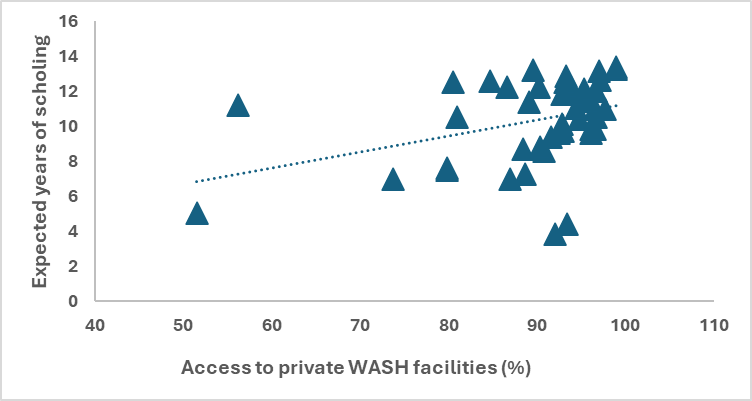
Source: World Bank Gender Data Portal. Note: The horizontal axis refers to women and girls who have private places to wash and change during menstrual period (as % of women and girls ages 15-49). Graph contains 20 African countries, and 20 countries form other developing regions.,
Evidence from Africa (other than North Africa) shows that each additional year of schooling for girls increases future earnings by about 15 percent on average due to higher productivity and improved employment opportunities in a region where average years of schooling remain among the lowest globally (Montenegro & Patrinos, 2014).[i] By reducing time poverty and enabling girls to remain in school, WASH investments can convert time saved today into a more skilled and productive workforce tomorrow. In this way, water and sanitation infrastructure strengthens human capital formation and expands the future productive frontier of African economies, alongside of improving social and welfare outcomes.
Africa already bears a heavy burden of inadequate water access. More than two thirds of the population lack access to safely managed drinking water, and only one-third have water available on premises (WHO&UNICEF, 2023).[ii] Without targeted public interventions, these gaps will continue to shape unequal economic outcomes for the next generation of women.
The risks of inadequate access to WASH are intensifying. UNICEF projects that by 2040 nearly one in four children globally will live in areas of extremely high water stress, and many of the most affected countries will be in Africa (UNICEF, 2017).[iii] Girls will be disproportionately affected, facing increased domestic labor burdens and reduced access to education as households cope with scarcity. Climate change, by increasing water scarcity across many parts of Africa, is likely to intensify these dynamics by lengthening the time required for water collection. Without climate-resilient water systems, these pressures risk amplifying existing gender inequalities while constraining future labor supply and productivity.
Adulthood: The high opportunity cost of unpaid water labor
As women transition into adulthood, WASH-related constraints remain a key barrier to economic participation. Across much of Africa, women and girls bear the primary responsibility for water collection, which is an unpaid task that carries a significant opportunity cost.
Country-level data illustrate the scale of this burden. According to WHO and UNICEF (2023), women and girls are responsible for water collection in 76 percent of households in Malawi, 73 percent in the Central African Republic, and 70 percent in Chad. In contrast, men and boys account for only 7 percent, 14 percent, and 8 percent of households, respectively. In Malawi, in half of the households, women and girls spend more than 30 minutes per day collecting water, with similar patterns observed in the Democratic Republic of Congo, Madagascar, and Zimbabwe. These lost hours translate into reduced participation in paid work, entrepreneurship, and skills development, resulting in output losses for households and economies.
Sanitation deficits compound these challenges. Almost three quarters of Africa’s population (other than North Africa) lack access to safely managed sanitation. During pregnancy and motherhood, inadequate WASH services heighten risks for both women and children. Poor sanitation and hygiene contribute to maternal and neonatal complications, increasing pressure on health systems and reducing productive employment. For women, this is not only a health issue but also a safety and economic concern. The absence of safe, private sanitation facilities increases women’s exposure to gender-based violence, restricts mobility, and limits their engagement in economic life and society more broadly. These risks impose broader social and economic costs that are rarely accounted for in policy decisions.
To sum, the limited access to hygiene products and facilities also affects women’s ability to remain in work, contributing to absenteeism, job insecurity, and lower earnings. These dynamics reinforce cycles of poverty and exclusion, particularly for women in informal and rural economies. The economic returns on WASH investments are clear. Estimates indicate that every dollar invested in water and sanitation generates an average return of $7 through increased productivity and reduced health care costs. For women, the returns are likely even higher. Improved WASH access frees time for education and income-generating activities, strengthens human capital, and amplifies benefits across families and communities. Yet realizing these gains requires moving beyond infrastructure delivery to address governance, data, and accountability.
Strategic priorities for 2026 and beyond
To unlock the full economic potential of WASH for women, four strategic shifts are essential.
-
First, gender-responsive budgeting. Governments cannot credibly prioritize WASH without explicit budget allocations for menstrual hygiene management in schools and for climate-resilient water systems in rural markets where women trade and work.
-
Second, better data disaggregation. Aggregated statistics obscure how water scarcity affects women-headed households, women, and girls differently at each stage of life. Disaggregated data is essential for targeted, effective policy design.
-
Third, meaningful inclusion of civil society. Civil society organizations are not merely beneficiaries of policy; they are co-architects. Their role in monitoring progress and holding governments accountable to Agenda 2030 and Agenda 2063 is indispensable.
-
Fourth, investing in digital and STEM skills for women. Expanding girls’ access to STEM education and digital training can enable women to design, manage, and innovate in climate-resilient water systems and participate in emerging sectors shaped by data, artificial intelligence, and digital technologies.
Gender equality in WASH is not a one-time intervention. Gender-responsive WASH policies improve educational outcomes, protect health, reduce unpaid labor burdens, and expand women’s economic participation across the lifecycle. Strengthening WASH systems is thus not only a social priority but investment in Africa’s human capital and long-term economic transformation.
[i] WaterAid (2024). Seven Ways that Water, Sanitation and Hygiene Enhances Women’s Economic Empowerment.
[ii] UNICEF & WHO. (2018). Drinking Water, Sanitation and Hygiene in Schools: Global Baseline Report.
[iii] Montenegro, C. E., & Patrinos, H. A. (2014). Comparable Estimates of Returns to Schooling Around the World. World Bank Policy Research Working Paper No. 7020.
[iv] WHO/UNICEF (2023) Joint Monitoring Programme for Water Supply, Sanitation and Hygiene. Progress on Household Drinking Water, Sanitation and Hygiene 2000–2022: Focus on Gender. Geneva: WHO&UNICEF.
[v] UNICEF, 2017. Thirsting for a Future: Water and Children in a Changing Climate. New York: UNICEF.