
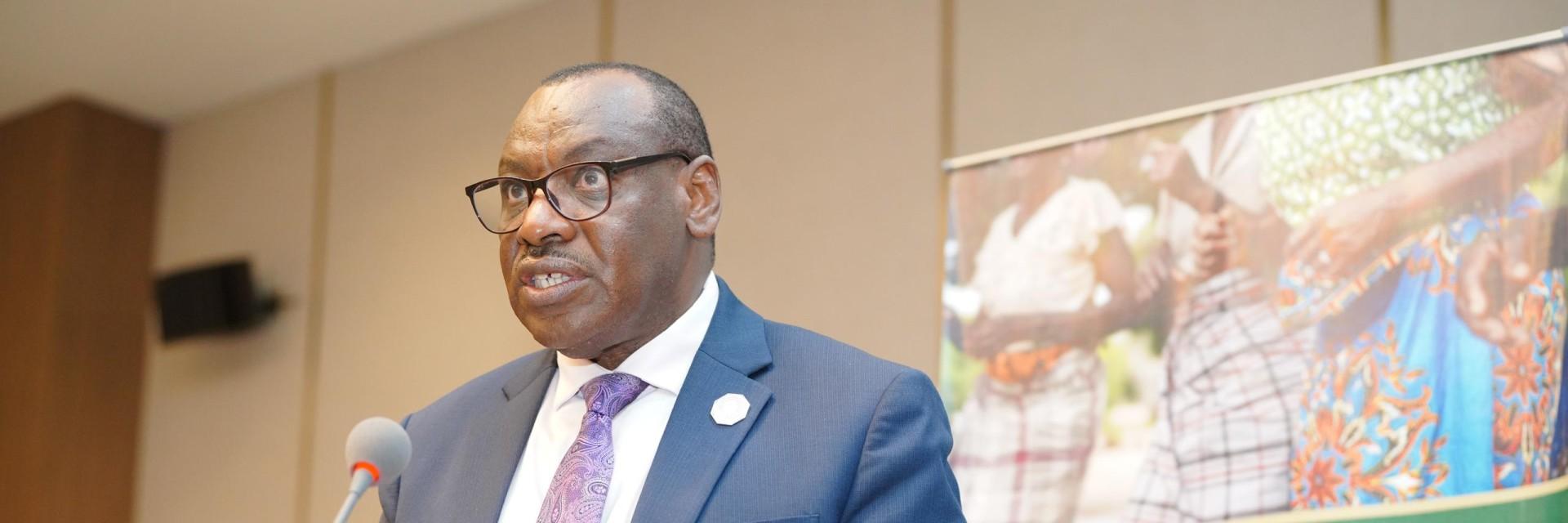
2026 AFRICAN UNION SUMMIT OF HEADS OF STATE AND GOVERNMENT
High-Level Side Event on Africa’s Health Sovereignty
Theme:
From Commitment to Action: Accelerating Health Financing, Partnerships and Delivery at Scale
Statement
By
Mr. Claver Gatete
United Nations Under-Secretary-General and
Executive Secretary of ECA
15 February 2026,
Addis Ababa, Ethiopia
H.E. John Dramani Mahama, President of the Republic of Ghana,
Excellencies, Heads of State and Government,
Honourable Ministers,
Distinguished partners and colleagues,
It is a privilege to join you on the margins of the African Union Summit for this important dialogue on accelerating health financing, partnerships and delivery at scale.
We meet at a moment when the international system itself is being re‑ordered.
The era of hyper‑globalisation is giving way to an era of strategic resilience.
Today, nations are reconsidering dependence in critical sectors and are redesigning supply chains to protect their national security, economic stability and social welfare.
In this new global landscape, health is no longer viewed simply as a social service.
It has become a strategic economic sector, alongside food, energy and technology.
Access to medicines, vaccines and medical inputs now shapes national stability, labour productivity and economic competitiveness.
The recent crises revealed a sobering reality: even advanced economies struggled to secure essential medical supplies when borders closed and exports were restricted.
The impact was not limited to hospitals. It slowed factories, reduced labour participation, disrupted education and weakened growth.
So, health shocks quickly became economic shocks, and economic shocks became development setbacks.
The question before us, therefore, is fundamental: who finances health, who produces medicines and who ultimately determines the health future of Africa?
And Africa today finds itself at a structural turning point.
Development assistance for health has declined sharply from about US$80 billion in 2021 to roughly US$39 billion in 2025.
At the same time, debt service pressures have risen and fiscal space has narrowed.
Meanwhile, although Africa spends approximately US$145 billion annually on health, governments finance less than half, which, unfortunately, leaves households to bear heavy out‑of‑pocket payments.
Across many countries, families sell productive assets to pay medical bills, workers exit employment and children are forced to leave school.
These are not only social but macroeconomic consequences.
If the effects are economic, the response must also be economic.
As a result, health financing cannot be an auxiliary budget line.
It must be integrated into national fiscal frameworks and financed predictably, just as nations finance infrastructure, energy and security.
However, no financing solution will be sufficient so long as limited public funds are used to purchase externally produced inputs.
The issue we confront is therefore not only fiscal ; it is structural and industrial.
It is unacceptable that a continent of over 1.5 billion people, carrying nearly a quarter of the global disease burden, is served by fewer than a thousand pharmaceutical manufacturers and produces only a small share of the medicines it consumes.
Import dependence exposes our health systems to external prices, external decisions and external disruptions.
But no single African country can generate the scale required for competitive pharmaceutical production alone.
This is precisely why the African Continental Free Trade Area is indispensable.
Through pooled procurement, regulatory harmonisation and regional value chains, the AfCFTA can become a health security instrument.
However, a continental solution requires continental economic coordination.
As such, the United Nations Economic Commission for Africa contributes by linking health financing to macro‑fiscal planning, domestic resource mobilisation, debt sustainability and regional integration.
To further support this effort, ECA is partnering with the Susan Thompson Buffett Foundation on a financing support arrangement to be presented to African Ministers of Finance at the ECA Conference of Ministers in Morocco this March.
Health sovereignty cannot be achieved by ministries of health alone. Finance, trade, industry and planning authorities must act together.
At this juncture, permit me, Excellencies, to propose four priorities for collective action.
First, we must integrate health financing into national development plans and medium‑term fiscal frameworks so prevention, primary healthcare and financial protection are funded predictably.
Second, we need to mobilise domestic resources through more efficient, digitized tax administration, health‑promoting taxes and innovative instruments such as blended finance, diaspora bonds and debt‑for‑health swaps.
Third, we must deliberately develop pharmaceutical and vaccine production through regulatory harmonisation, technology transfer and private investment.
Through AfCFTA‑enabled value chains, medicines can be produced competitively within Africa rather than imported at high cost and risk.
Without predictable financing, even the best policies cannot endure.
Fourth, we must strengthen health systems as economic infrastructure.
Producing medicines is only half the task; delivering them reliably is the other half.
Laboratories, surveillance networks, digital health platforms, cold chains and workforce training should be treated like ports, power plants and transport corridors.
Health security is national security, and a healthy workforce is the foundation of economic transformation.
Excellencies,
The choices we make now will determine whether Africa participates in the global health economy or remains dependent on it.
Will we remain consumers in the global health system, or become producers within it?
Health sovereignty is ultimately a question of economic sovereignty.
Through our evidence‑based analysis, convening power and implementation partnerships, the United Nations Economic Commission for Africa is ever ready to support Member States to build health systems financed by African resources, supplied by African industry and guided by African policy.
I thank you.