ARABIC LANGUAGE DAY 2025
Theme:
Innovative pathways for Arabic: policies and practices for a more inclusive linguistic future
Remarks
By
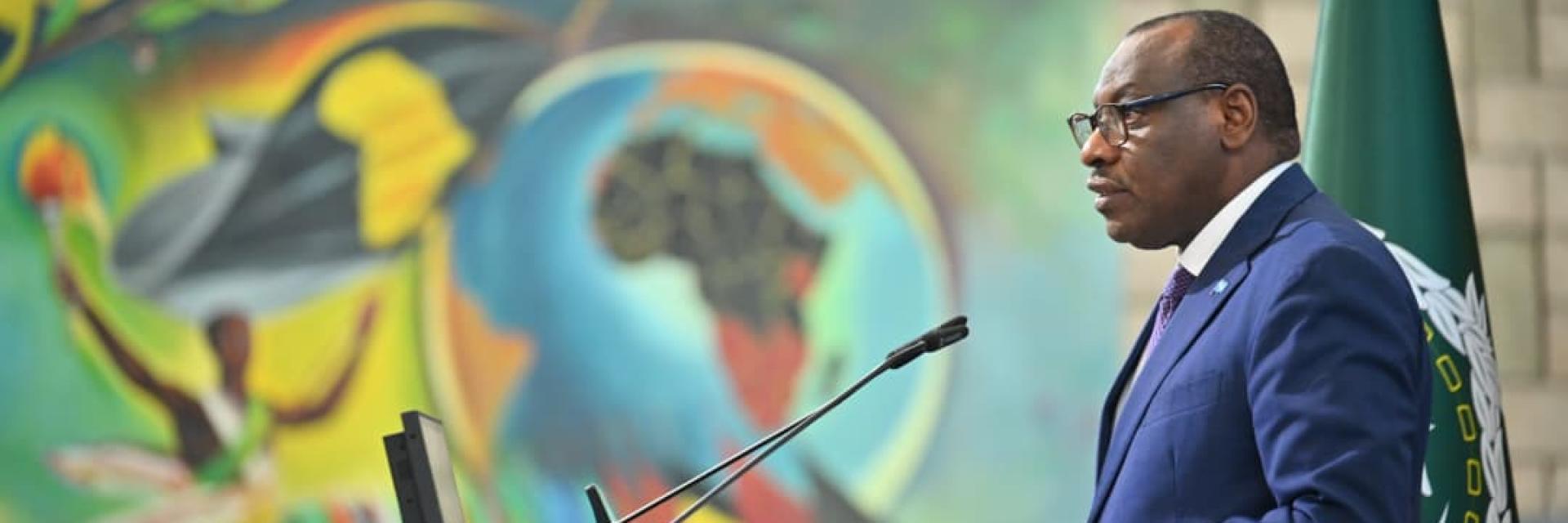
Mr. Claver Gatete
United Nations Under-Secretary-General and
Executive Secretary of ECA
Africa Hall, ECA, Addis Ababa
16 December 2025
Your Excellency, the President of the Council of Arab Ambassadors in Addis Ababa, Nezha Alaoui M’Hammdi,
Your Excellency, the Representative of the League of Arab States and Head of the Permanent Mission to the African Union and the Economic Commission for Africa, Mohamed Omar Almarhoun,
Your Excellencies the ambassadors and representatives of the diplomatic corps accredited to Addis Ababa,
Distinguished guests and dear friends and colleagues from the United Nations family,
Ladies and Gentlemen:
It gives me great pleasure to welcome you to the Economic Commission for Africa to celebrate Arabic Language Day.
As we reflect on the significance of this occasion, it becomes immediately clear that multilingualism and its active promotion are central to the work of the United Nations.
Accordingly, throughout the year, we commemorate the official languages of the United Nations, as well as International Mother Language Day and International Translation Day.
Arabic Language Day brings to a close this cycle of events devoted to linguistic and cultural diversity, which is being celebrated under the inspiring theme: “Innovative pathways for Arabic: policies and practices for a more inclusive linguistic future.”
Indeed, this theme raises a profound question: how can a language take full advantage of modern technologies while retaining its heritage, culture and soul?
In other words, how can Arabic – like all the world’s languages – project itself into the future, in an environment dominated by information and communications technology, while remaining true to its identity?
To answer these questions, we must focus on three interlinked-pillars: education and training in Arabic; the use of the language in various social and institutional spaces; and the language’s active role in innovation and new technologies.
In our current digital age, the extent to which a language thrives depends largely on its presence on online platforms, in educational systems, in the media and in public discourse.
And naturally, Arabic is no exception.
Thus, its future will be shaped through these various channels.
In this regard, education plays a central role: it facilitates not only the acquisition of language but also access to knowledge through that language.
It is therefore necessary to revitalize Arabic teaching, to integrate it with information technologies more fully and to promote an inclusive multilingualism, promoting Arabic alongside other languages.
This, in turn, requires curricula that are updated to reflect contemporary realities, with clear emphasis on communication skills and digital competencies.
Excellencies,
Distinguished Ladies and Gentlemen:
There are several possible approaches to achieve this.
First is an inclusive approach, which takes into account the cultural and linguistic diversity of learners and fosters a respectful and open learning environment.
This requires teacher training that is future-oriented and sensitive to changes in society.
Second is an approach based on the status of the language, aimed at raising the profile of Arabic, which often must compete with other languages.
The aim is not to fuel competition, but rather to make Arabic a vehicle for cultural diversity, tolerance and mutual understanding among peoples.
And third is a technological approach, which is indispensable today.
The use of artificial intelligence – whether through automatic translation, voice recognition and Arabic content generation – is a major area of innovation.
Likewise, the production of good-quality Arabic-language content on the Internet, including social networks, is also a powerful tool for enhancing the language’s standing and influence.
In short, the innovative approaches that we are discussing today will adapt Arabic to the demands of modern life and globalization, while preserving its cultural roots and identity.
Ultimately, the future of Arabic lies in education, technology and inclusive language policies.
Excellencies,
Ladies and Gentlemen,
This year marks a significant milestone as both the League of Arab States and the United Nations celebrate eighty years of service to humanity.
Over these decades, our two institutions have worked – each in its own mandate – to promote peace, reconciliation, development and mutual understanding across regions.
This is an opportunity to recognize the achievements and to call for closer collaboration between our organizations, for the well-being of the peoples whom we serve.
Multilingualism and cultural diversity are essential pillars in that respect.
At this juncture, I wish to convey my heartfelt appreciation to the League of Arab States, its Permanent Mission to the African Union and ECA, the Council of Arab Ambassadors and all diplomatic missions accredited to Ethiopia.
Likewise, I extend sincere thanks to all our partners committed to multilingualism for participating in and supporting this celebration.
Lastly, I would like to thank every participant here with us today.
Without you, this commemoration would not have been possible.
I wish you all a very happy holiday season.
Have a Merry Christmas and an excellent New Year!