
![[Blog] U.S. Enactment of the GENIUS Act: Impact on Africa](https://www.uneca.org/sites/default/files/styles/slider_image/public/storyimages/shutterstock_1502818772_1920x640.jpg?itok=JcWhrn2P)
*Disclaimer: The views expressed in this paper are exclusively attributed to the author.
The rapid growth of blockchain technologies has accelerated the use of digital assets, including cryptocurrencies and stablecoins, offering new ways to store and transfer value through peer-to-peer and cross-border transactions, among other.
While stablecoins can advance financial inclusion in Africa, the emergence of a new asset class and medium of exchange has elevated emerging financial threats such as digital based fraud and scams by fraudsters that are increasingly leveraging generative AI to scale attacks and create highly personalized scams.
At a macroeconomic level, the growth of stablecoins imposes unprecedented fiscal and monetary risks on developing countries, many of which are currently the subjects of intense discussion within African central banks and government ministries responsible for finance, such as: a) deposit substitution and liquidity drain when capital is shifted from local money and capital markets to stablecoins; b) weakened credibility of monetary policy when central bank open market operations are rendered impotent by the circulation of unknown quantities of foreign denominated stablecoins, since these transactions operate on decentralized blockchain networks that bypass traditional banking intermediaries, thus creating a "parallel shadow money supply" which causes a catastrophic loss of monetary sovereignty; c) constriction of fiscal policy options due to erosion of the tax base, since peer-to-peer (P2P) stablecoin transactions are largely hidden; d) depletion of foreign exchange reserves when African businesses increasingly use stablecoins for cross-border trade and repatriation of earnings; e) elevated Inflationary pressures when the exchange rate and velocity of the local currency change unpredictably.
In response to broader macroeconomic challenges and concerns around stablecoin growth, the United States enacted the “Guiding and Establishing National Innovation for U.S. Stablecoins Act” (GENIUS Act) in July 2025. Scheduled to enter into force on January 18, 2027, the Act establishes federal oversight and requires stablecoin issuers to back their stablecoin one-to-one with liquid assets such as U.S. dollars or short-term Treasury securities.
Exposure of African countries to global cryptocurrency markets
Sub-Saharan African countries have tremendous, concentrated exposure to U.S. dollar-denominated stablecoins and other crypto-assets, with the continent processing over US$ 205 billion in on-chain value between 2024 and 2025 - elevating Africa to third fastest growing market for cryptocurrencies. The continent’s popularity with cryptocurrencies is driven by widespread exchange rate volatility, forex controls, high inflation, a large unbanked population, and speculative motivations – thus, accelerating stablecoin’s widespread adoption as an ideal store of value that hedges against economic volatility.
Figure 1: Top 10 African countries with highest exposure to cryptocurrencies, 2024 – 2025 (US$, billion)
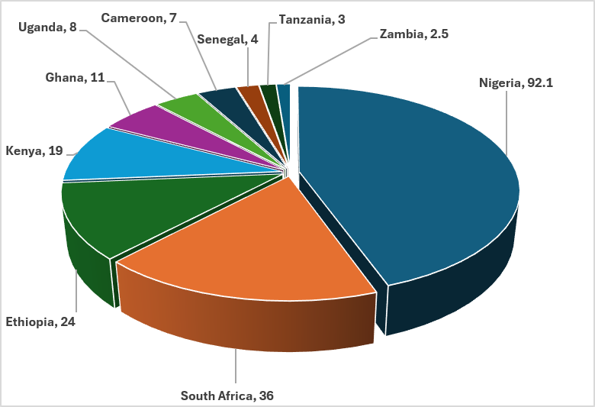
Source: Mexc (2026)
While data is scanty due to the highly unregulated nature of global crypto markets, it is no surprise that Nigeria tops the list of African countries with the greatest adoption, due to its relatively high GDP, population, and exchange rate controls that motivate its citizens to actively use Bitcoin and stablecoins to bypass tight foreign currency controls and high inflation. Notably, more developed financial markets, such as South Africa, have significant speculative motivations, with retail investors using crypto markets to reap cheap returns from asset appreciation.
Should Africa care about the U.S. GENIUS Act?
It is encouraging that the largest economies on the continent have been proactive by enacting regulations that respond to the rapid growth of Africa’s cryptocurrency exposure. Thus, governments are shifting from blanket bans to active regulation. While a few countries, such as Algeria and Egypt, continue to restrict or outright ban digital assets, other countries including Kenya, South Africa, and Nigeria are establishing licensing, stablecoin oversight, cybersecurity and regulatory sandboxes, similar to the GENIUS Act. This structural and regulatory shift allows digital currencies to operate as legitimate components of their financial architectures by formally integrating digital assets into domestic financial systems.
This policy shift is partially motivated by the need to institutionalize safe and cheaper channels for remittances and business transactions since cross-border transactions are extremely expensive, with average remittance fees lingering around 6.5%.
Significantly, since 99% of stablecoins in circulation are U.S. dollar denominated, the GENIUS Act accelerates a shift away from local currencies towards the “digital dollar,” at a time when U.S. macroeconomic volatility is high ( e.g. global U.S. dollar reserves are under 58% from 70% in 2000; high sovereign debt of US$ 39.3 trillion from US$ 3.32 in 2001). When the Act enters into force, it’s expected that the growth of stablecoin markets will accelerate – thus propagating the widespread dollarization of African economies.
Furthermore, since the GENIUS Act mandates that both local and foreign stablecoin issuers must comply with U.S. asset-freezing orders and avoid sanctioned jurisdictions from interacting with U.S. centralized trading platforms, the Act strengthens the power of U.S. financial and trade sanctions, which have historically devastated African countries such as Sudan, Zimbabwe, and Eritrea.
Parting words
Africa should immediately respond to the U.S. enactment of the GENIUS Act by formulating precautionary regulatory measures on digital assets including firm controls on the amount of foreign denominated digital assets that are allowed to circulate in their economies, as well as mandatory information provision by stablecoin issuers to aid monetary authorities in managing risks emanating from instruments that are beyond their direct jurisdiction, among others. To avoid monetary policy under/overshooting and other adverse effects of stablecoin control, African countries must deploy their local talent towards the development of predictive economic models that integrate the dynamics of digital assets. On the fiscal side, regulators must modernize tax compliance frameworks and measures against illicit financial flows to realistically reflect the risks associated with proliferation of digital assets within their economies.
Before the Act enters into force, Africa urgently needs a regional common position and governing policy to prevent sophisticated crypto issuers from leveraging on arbitrage opportunities that may arise from fragmented unilateral action – as Africa accelerates the regional adoption of its homegrown stablecoins that must be integrated into cross-border and regional payment systems such as the PAPSS.
The continued emergence and proliferation of modern financial risks should provide the impetus for the urgent establishment the African Central Bank.