
2026 HIGH-LEVEL POLITICAL FORUM (HLPF)
Advancing Energy and Digital Connectivity for Economic Growth and Sustainable Development in Africa
Statement
By
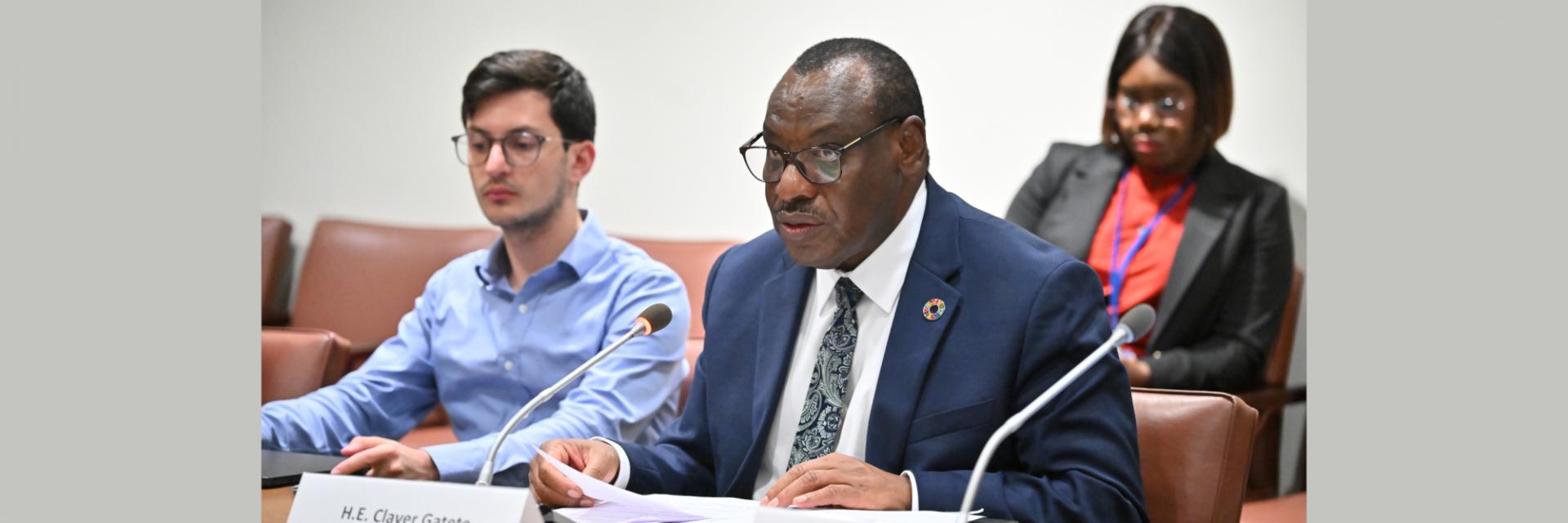
Mr. Claver Gatete
United Nations Under-Secretary-General and
Executive Secretary of ECA
New York
15 July 2026
Excellencies,
Distinguished delegates,
Colleagues,
Ladies and gentlemen:
Let me begin by thanking the Governments of Angola, Morocco and Italy, together with the OECD and all partners, for convening this important discussion on a subject that sits at the heart of Africa’s development future: energy and digital connectivity.
Indeed, far from being merely about infrastructure, they are foundational enablers of economic transformation, industrialization and sustainable development.
This is especially crucial because we are meeting at a time of profound global uncertainty.
Around the world, economies are navigating geopolitical fragmentation, supply chain reconfiguration, climate shocks, technological disruption and rising financing constraints.
Yet in the midst of these challenges, one reality is becoming increasingly clear: in the twenty-first century, connectivity is development.
The countries that will thrive are those that can connect people to power, businesses to markets, ideas to innovation and communities to opportunity.
However, how can a country industrialize without reliable electricity?
Can it compete in the digital economy if millions remain disconnected from the internet?
The answer, of course, is no.
We learn from history that every major wave of economic transformation has been built on infrastructure.
Yesterday it was roads, railways and power plants.
Today it is those same foundations reinforced by digital networks, data systems and smart technologies.
Africa understands this well.
The continent is home to more than 1.5 billion people today, and by 2050 one in every four people on earth will be African.
This is an economic reality that will impact global growth, markets, labour forces and innovation for decades to come.
Yet the connectivity gaps remain significant.
Over 600 million Africans still lack access to electricity, representing almost half of the population of sub-Saharan Africa.
Meanwhile, only about 38% of Africans were using the internet in 2024, far below the global average of 68%.
These are development deficits because they represent missed opportunities for entrepreneurs, factories operating below capacity, farmers unable to access digital markets and young people unable to fully participate in the knowledge economy.
And yet, despite these challenges, our story is not solely about deficits.
It is also about opportunity.
Africa possesses some of the world’s greatest renewable energy resources. The continent also holds many of the critical minerals that will power the global energy transition. It is home to one of the youngest populations in the world and a rapidly expanding digital ecosystem.
The question is therefore not whether Africa has assets. We know we do.
The question is whether Africa can connect those assets to value creation.
Can we move from exporting raw materials to exporting batteries, electric vehicles and clean technologies?
Can we transform mineral wealth into manufacturing capacity?
And can we convert renewable potential into industrial competitiveness?
These are the questions before us.
The good news is that promising solutions are already emerging.
For example, the Lobito Corridor represents much more than a transport project. With over US$10 billion in commitments, it is becoming a platform for regional integration, trade, industrial development and strategic connectivity.
Similarly, the Morocco–Zambia–Democratic Republic of the Congo electric mobility initiative illustrates how African countries can work together under the AfCFTA to build regional value chains in batteries, electric mobility and associated industries.
This is precisely the type of value addition and industrial cooperation Africa needs.
What both examples illustrate is a broader lesson.
Infrastructure should not be viewed merely as concrete and steel. It must be viewed as an ecosystem.
A corridor is not just a railway.
It is energy, logistics, digital systems, trade facilitation, industrial parks, skills development and jobs.
Connectivity is not simply about access.
It is about transformation.
Excellencies,
As we prepare for the Fourth Decade of Africa’s Industrialization, today’s discussion is therefore timely and strategic.
As such, the choices we make today will determine whether connectivity becomes Africa’s greatest development accelerator.
Allow me to propose five priorities.
First, we must invest in integrated connectivity solutions that combine energy, transport and digital infrastructure rather than treating them as separate sectors.
Second, we must accelerate regional value chains through the AfCFTA so that connectivity translates into industrialization, value addition and productive jobs.
Third, we must close Africa’s infrastructure financing gap through innovative financing, stronger public-private partnerships and greater support from development finance institutions.
Fourth, we must build digital capabilities and skills alongside physical infrastructure. Connectivity without human capital will not deliver transformation.
Fifth, we must strengthen partnerships based on mutual benefit and shared prosperity. The challenges are too large for any country or institution alone, but together they are entirely within reach.
As I conclude, I invite us to pause for reflection.
If the twenty-first century will be defined by clean energy, digital innovation and resilient supply chains, should Africa remain merely a participant, or should it become a leader?
Our answer must be clear.
Africa must take charge and lead because we can.
We must be a leader in green industrialization, in digital innovation and in building the connected economies of the future.
The opportunity is before us. The resources exist and the partnerships are growing.
What is now required is scale, speed and collective action.
And as always, the United Nations Economic Commission for Africa remains committed to work with all partners to turn these opportunities into measurable results.
I thank you.